How to Make Your Pages Easier for Google AI Overviews to Cite
Author: Kevin C. Roy · GreenBanana SEO · Published: 2026-06-18
Google AI Overviews do not appear to cite pages randomly. To improve your odds, your page needs to be crawlable, indexed, clear, structured, and easy to extract for a specific answer. The biggest practical shift is simple: answer earlier, prove faster, and organize the page so Google’s AI can quickly understand what the page says and why it should be trusted.
What Changed?
 Google Search is no longer only showing a ranked list of webpages.
For more queries, Google may generate an AI Overview that summarizes an answer and links to supporting sources. That changes the job of SEO.
The old goal was mostly:
“Can we rank?”
The new goal is:
“Can we rank, be understood, and be cited as a source?”
Those are not the same thing.
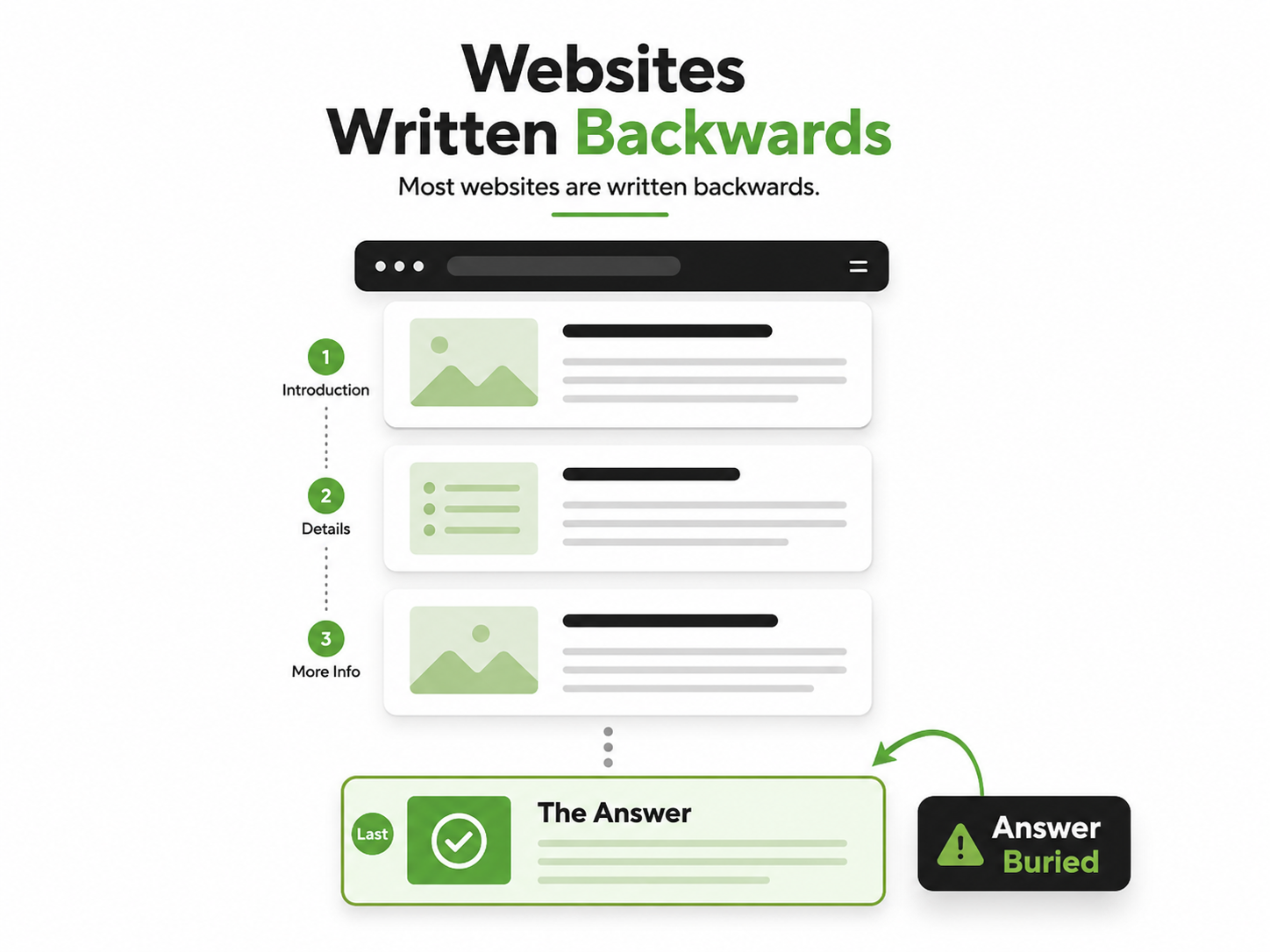
A page can rank and still be a poor AI source if the answer is buried, the structure is messy, or the content sounds like every other page on the internet.
Google has said there are no special technical requirements to appear in AI Overviews or AI Mode. You still need the basics: indexing, crawlability, snippet eligibility, accessible text, sound technical SEO, and content that fits Google’s quality systems.
But after that, source selection becomes a practical content problem.
Can the system identify the answer?
Can it connect that answer to the query?
Can it find support?
Can it trust the page enough to show it?
That is where structure matters.
Why It Matters
Buyers are increasingly getting answers before they click.
That means your content may influence the sale even when the user does not immediately land on your site.
This is especially important for:
- Local service businesses
- B2B companies
- Medical, legal, financial, and technical categories
- Ecommerce brands
- SaaS companies
- Agencies and consultants
- Any business where trust affects the buying decision
If Google’s AI Overview cites your competitor and not you, the buyer may form an opinion before they ever visit a website.
That is the part most companies are missing.
AI visibility is not just about traffic.
It is about who gets trusted at the moment the answer is formed.
What Actually Works Now?
The companies winning in AI search are not always the ones writing the longest pages.
They are usually the ones making their best information easier to find, extract, and verify.

AI Overview Source Selection: Practical Breakdown
| Page Element | Why It Matters | What To Do |
|---|---|---|
| Direct opening answer | AI systems need a clean answer to retrieve and summarize | Start key pages and sections with the answer first |
| Clear headings | Headings help separate topics and subtopics | Use plain-language H2s and H3s that match real questions |
| Short paragraphs | Long walls of text make extraction harder | Keep paragraphs tight and focused |
| Bullet summaries | Bullets make facts easier to scan and reuse | Add short summaries near the top of key sections |
| Tables | Comparisons are easier to understand in table form | Use tables for pros/cons, pricing factors, features, steps, and criteria |
| Proof points | AI needs evidence, not generic claims | Include examples, data, reviews, use cases, process details, and first-hand experience |
| Internal links | Links clarify topical relationships | Connect service pages, supporting articles, FAQs, case studies, and location pages |
| Schema | Schema can help confirm page meaning when used correctly | Add structured data only when it matches visible content |
| Third-party validation | AI systems may compare what you say with what others say | Build real mentions, reviews, citations, and profiles across trusted sources |
What Most Companies Get Wrong
The mistake is thinking AI search is solved by adding more content.
It usually is not.
More content can help when the content is useful.
But more vague content just creates a bigger mess.
A 2,000-word service page that hides the answer under generic sales copy is not stronger than a 900-word page that gives a clear answer, explains the process, proves the claim, and links to supporting pages.
The problem is not always depth.
The problem is extractability.
If Google’s AI cannot quickly understand what your page answers, why it is credible, and where the supporting proof lives, you are making the system work too hard.
And AI systems do not reward pages for making them work harder.
The A.P.P. Framework: Answer, Proof, Path
Use this framework to tighten pages for AI Overviews, AI Mode, ChatGPT, Gemini, Perplexity, and other AI search systems.

1. Answer
Lead with the direct answer.
Do not build up to it.
Bad structure:
“Choosing the right SEO company can be difficult. There are many factors to consider. Businesses today need visibility…”
Better structure:
“The best SEO company for a business is the one that can prove technical competence, content strategy, authority building, reporting discipline, and measurable business outcomes.”
Then explain.
The answer-first format helps both people and machines.
People get clarity.
AI gets a clean passage to extract.
2. Proof
 Add evidence immediately after the answer.
Examples of proof:
- Original data
- Real client examples
- Before-and-after comparisons
- Reviews
- Case studies
- Screenshots
- Named tools
- Specific processes
- Years of experience
- Third-party mentions
- Certifications
- Expert authorship
AI does not need you to sound impressive.
It needs reasons to trust the page.
Generic claims are weak.
Specific proof is stronger.
3. Path
 Make the page easy to navigate.
A strong page should have a clear path from question to answer to proof to next step.
Use:
- H2s for major questions
- H3s for supporting details
- Tables for comparisons
- Bullets for key facts
- FAQs for direct questions
- Internal links to related services and supporting content
- Schema where appropriate
- Descriptive anchor text
- Clean page templates
The goal is not to “write for robots.”
The goal is to make the page clear enough that both humans and machines understand it.
Quick Audit: Fix One Page in 20 Minutes
Pick one important service page.
Then review these areas:
| Audit Question | Pass / Fail |
|---|---|
| Does the page answer the main question in the first 100–150 words? | |
| Does the page include a short summary or bullet list near the top? | |
| Are the headings written like real questions or clear topics? | |
| Does each section start with a direct answer? | |
| Are claims supported with proof? | |
| Is there a comparison table where useful? | |
| Does the page link to related pages, case studies, FAQs, or supporting articles? | |
| Is the visible content aligned with the schema? | |
| Could a buyer understand the page quickly? | |
| Could AI extract one clean answer from the page? |
If the page fails more than three of these, it probably needs restructuring.
Not necessarily rewriting.
Restructuring.
That distinction matters.
What To Do Next
Start with your highest-value pages.
Usually that means:
- Core service pages
- Product category pages
- Location pages
- Comparison pages
- FAQ or buyer-intent pages
- Case study pages
- Pages already earning impressions but weak clicks
Then apply the same cleanup process:
- Move the answer higher
- Cut the generic intro
- Add a short answer block
- Break up long sections
- Add proof
- Use clearer headings
- Add internal links
- Add schema only where it matches the content
- Remove claims you cannot support
This does not require blowing up the entire website.
Most companies can improve AI extractability by fixing the structure of pages they already have.

Key Takeaway
AI Overviews reward clarity, not cleverness.
Your page still needs traditional SEO fundamentals. It still needs to be crawlable, indexed, useful, and trusted.
But once you are in the game, structure matters.
If your best answer is buried, vague, or unsupported, you are making it harder for AI to cite you.
Answer first.
Prove it.
Give the page a clear path.
That is the practical work.
Follow-Up Questions
- How do I know if Google AI Overviews are citing my competitors instead of me?
- What pages should I optimize first for AI citations?
- Does schema help with AI Overviews, or is it overrated?
- How should service pages be structured for AEO and GEO?
- What is the difference between ranking in Google and being cited by AI?
Frequently Asked Questions About AEO
What is AEO?
AEO stands for Answer Engine Optimization. It is the process of structuring content so AI systems can understand, extract, and cite clear answers from a page.
How do Google AI Overviews choose sources?
Google AI Overviews tend to cite pages that are crawlable, indexed, relevant, clearly structured, and easy to extract for a specific answer.
Why is answer-first content important for AI Overviews?
Answer-first content helps both people and AI systems find the main point quickly. When the answer is buried under a long introduction, it becomes harder for AI to identify and cite the most useful passage.
What is the A.P.P. framework?
The A.P.P. framework stands for Answer, Proof, Path. It means leading with the direct answer, supporting it with evidence, and organizing the page so users and AI systems can follow the information clearly.
Does schema help with AEO?
Schema can help confirm what a page is about when it matches the visible content. It should support the page structure, not replace clear writing, useful proof, or strong on-page organization.
What makes a page easier for AI to cite?
A page is easier for AI to cite when it has a direct answer near the top, clear headings, short paragraphs, useful proof, internal links, relevant schema, and content that is easy to crawl and understand.
What should businesses optimize first for AI citations?
Businesses should start with one important service page or high-value page. The first step is to check whether the page answers the buyer’s question directly, includes proof, uses clear headings, and gives AI one clean answer to extract.
Is ranking the same as being cited by AI?
No. Ranking can help a page become visible in search, but being cited by AI depends on whether the page is clear, extractable, supported, and useful as a source for a specific answer.
Ready to talk AEO?
Contact GreenBanana SEO to start a conversation about AEO.