What Are ChatGPT Ads? How Product Feeds, Conversion Tracking, and oCPC Work
ChatGPT Ads are rapidly evolving beyond basic sponsored placements. OpenAI now supports retail product feeds, conversion measurement through the OpenAI Pixel and Conversions API, custom audiences, conversion-optimized CPC campaigns, advanced matching, and newly reported multi-product carousel ads. The opportunity is significant, but advertisers should prioritize feed accuracy, conversion tracking, attribution reconciliation and disciplined testing before scaling spend.
What Changed With ChatGPT Ads?
The important development is not simply that ChatGPT contains advertising.
It is the infrastructure OpenAI is building behind that advertising.
OpenAI Ads Manager Beta now includes capabilities increasingly familiar to experienced paid-media teams:
| Capability | What It Does | Why It Matters |
|---|---|---|
| Product feeds | Turns structured retail catalog data into eligible ads | Allows large ecommerce catalogs to participate at scale |
| OpenAI Pixel | Sends website conversion events to OpenAI | Provides post-click measurement |
| Conversions API | Sends conversion events server-side | Can make measurement more resilient |
| Custom audiences | Uses eligible first-party customer/prospect lists | Adds audience inclusion, exclusion and bid adjustments |
| oCPC | Optimizes click bidding toward a selected conversion event | Moves optimization beyond traffic alone |
| Automatic Advanced Matching | Uses eligible normalized and hashed first-party signals to improve matching | May improve conversion attribution |
| Product carousel ads | Can display multiple feed products within one ad placement | Makes ChatGPT advertising more commerce-oriented |
OpenAI Ads Manager remains a beta product, so features and availability can continue changing. (OpenAI Help Center)
But the direction is becoming clear.
This is increasingly recognizable as performance-media infrastructure.
Product Feed Campaigns Are Here

OpenAI officially supports Product feed as a campaign type.
Retail advertisers can upload a structured product feed into Ads Manager and create campaigns against products contained in that catalog.
OpenAI says product-feed advertisers have been among the strongest performers in its ad program to date. (OpenAI Help Center)
Current product-feed setup includes:
- Creating a feed inside Ads Manager
- Uploading feed data through SFTP
- Selecting Product feed as the campaign type
- Filtering eligible products
- Creating an ad template
- Reviewing product titles, descriptions, images and landing pages before launch
OpenAI’s documentation specifically tells advertisers to validate product titles, descriptions, images and destination pages before submitting a feed campaign. (OpenAI Help Center)
That makes feed quality a performance variable, not simply an ecommerce housekeeping task.
Product Feed Does Not Mean “Carousel Campaign”


This distinction is worth understanding.
Product feed is the advertiser-facing campaign type.
Carousel is one possible user-facing presentation format.
OpenAI’s existing Help Center documentation still describes Product feed as the campaign type. Digiday reported on August 6, 2026 that OpenAI was introducing a carousel ad format capable of showing multiple products from a retailer’s feed, with industry examples appearing shortly afterward. (OpenAI Help Center)
Advertisers therefore should not expect a separate “Create Carousel Campaign” control.
The underlying product catalog gives OpenAI inventory it can use when assembling eligible ad experiences.
Do Not Confuse ChatGPT Shopping Results With ChatGPT Ads
This is particularly important because the two experiences may look increasingly similar.
ChatGPT can organically display:
- Product images
- Prices
- Recommendations
- Merchant options
- Product comparisons
- Purchase links
But OpenAI states that these product results are independently selected and are not ads. Advertising is handled separately. (OpenAI Help Center)
That means an ecommerce company effectively has two different visibility opportunities inside ChatGPT:
Organic commerce visibility
Can ChatGPT discover, understand and recommend the product?
Paid commerce visibility
Can the retailer intentionally promote eligible products through ChatGPT Ads?
Those should be measured separately.
ChatGPT Ads Now Have Conversion Optimization
OpenAI now supports conversion-optimized cost-per-click campaigns, or oCPC.
With oCPC, billing still occurs on valid clicks.
The difference is optimization.
OpenAI uses predicted conversion likelihood to determine its per-click auction bid while optimizing delivery toward the advertiser’s selected standard conversion event. (OpenAI Help Center)
Examples include:
- Purchase
- Registration
- Lead submission
- Sign-up
- Other supported standard conversion events
This is an important distinction.
CPC
Optimize toward clicks from users likely to engage.
oCPC
Optimize toward clicks more likely to generate a selected downstream conversion.
OpenAI currently requires advertisers to create a new conversion-objective campaign to use oCPC. Existing CPC or CPM campaigns cannot simply be switched into oCPC, and custom conversion events are not currently supported for oCPC. (OpenAI Help Center)
Why Conversational Advertising Could Be Different

Traditional paid search frequently begins with a short query.
For example:
best marathon shoes
A ChatGPT conversation may instead contain:
Training for the Boston Marathon, pavement runner, overpronates, previous Achilles problem, 190 pounds, budget below $180.
Those two interactions may express the same basic purchasing intent.
But the second contains substantially more context.
OpenAI says ChatGPT advertising considers conversational intent and other permitted relevance signals rather than functioning simply as keyword matching. (OpenAI Help Center)
That creates an interesting performance-marketing possibility:
The conversation itself can provide information about what the person is trying to accomplish.
That does not guarantee better advertising performance.
It does mean the relevance problem is structurally different from bidding against a few keywords.
What Most Ecommerce Advertisers Will Get Wrong
The first mistake will be treating product-feed advertising like a technical integration.
It is really a data-quality problem.
Consider what happens when catalog information is wrong:
| Feed Problem | Potential Outcome |
|---|---|
| Weak product title | Less useful product presentation |
| Thin description | Less context for matching and presentation |
| Incorrect price | Poor user experience |
| Stale inventory | Ad promotes unavailable product |
| Broken URL | Paid click reaches a dead destination |
| Poor image | Weak visual presentation |
| Incorrect variant data | User lands on the wrong product |
| Feed/store mismatch | Reporting and customer experience problems |
The practical lesson:
Do not simply connect your ecommerce catalog and assume the job is finished.
Audit the feed first.
A Five-Part ChatGPT Ads Readiness Framework
1. Feed
Audit the catalog fields being supplied to OpenAI.
At minimum, review:
- Product names
- Product descriptions
- Images
- Prices
- Availability
- Landing pages
- Product IDs
- Variants
- Category information
OpenAI specifically advises validating titles, descriptions, images and landing pages before launch. (OpenAI Help Center)
2. Tracking
Install and validate measurement before evaluating performance.
OpenAI currently supports:
- OpenAI JavaScript Pixel
- Conversions API
- Pixel + Conversions API together
- UTMs for external analytics
When Pixel and CAPI send the same conversion, OpenAI recommends using the same event ID so the platform can deduplicate those events. (OpenAI Help Center)
3. Optimization
Do not immediately assume oCPC will outperform CPC.
Test it.
For an oCPC campaign, select the conversion event that most closely represents the actual business objective and make sure the event occurs frequently enough to generate meaningful signal. (OpenAI Help Center)
For ecommerce, that may eventually be purchase.
For lead generation, it may be qualified form submission.
The correct event depends on the funnel.
4. Reconciliation
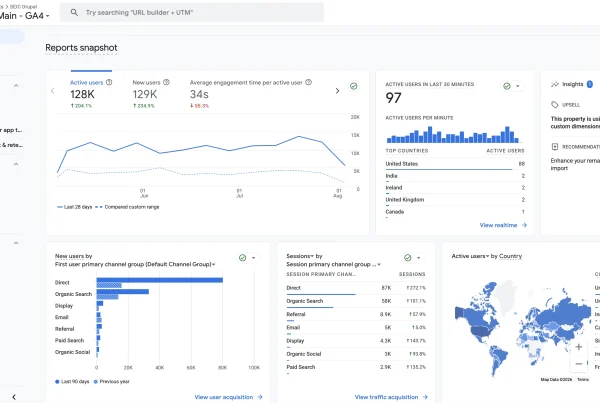
Do not expect OpenAI Ads Manager, GA4 and your ecommerce platform to report identical conversion totals.
OpenAI says discrepancies can result from:
- Different attribution methods
- Different attribution windows
- Timestamp and timezone differences
- Browser and consent conditions
- Different deduplication behavior
- Campaign configuration
- Modeled conversions
A discrepancy does not automatically mean one platform is broken. (OpenAI Help Center)
Build a reconciliation process rather than chasing perfect numerical equality.
5. Separate Paid AI From Organic AI
Do not combine ChatGPT advertising performance with AI-search visibility.
For paid ChatGPT campaigns, measure:
- Impressions
- Clicks
- CTR
- CPC
- Conversions
- Cost per conversion
- Revenue
- CAC
- ROAS
For organic AI visibility, measure:
- Brand mentions
- Brand recommendations
- Citations
- Query coverage
- Sentiment
- Sources producing citations
- Competitor share of AI answers
OpenAI explicitly separates organic shopping recommendations from advertising. (OpenAI Help Center)
Treat them as separate acquisition disciplines.
Automatic Advanced Matching Changes on August 17
Advertisers using the OpenAI Pixel should also review Automatic Advanced Matching.
OpenAI says AAM is already enabled by default for newly created Web pixels.
On August 17, 2026, OpenAI plans to enable it for existing Web pixels unless the advertiser opts out. (OpenAI Help Center)
When enabled, OpenAI says the Pixel can detect supported customer information entered into forms, normalize it and hash it in the browser using SHA-256 before including the matching information with conversion events. OpenAI says raw customer information is not transmitted through Automatic Advanced Matching. (OpenAI Help Center)
This is not necessarily a reason to disable the feature.
It is a reason to make sure the people responsible for:
- Marketing
- Analytics
- Privacy
- Legal/compliance
know that it exists and have reviewed the implementation.
What Should Advertisers Do Next?
For most businesses, the immediate opportunity is not “spend as much as possible on ChatGPT.”
The better sequence is:
- Obtain access to Ads Manager where available.
- Establish clean baseline measurement.
- Connect and validate conversion events.
- Ecommerce advertisers should audit their product catalog.
- Reconcile inventory, URLs and prices against the live store.
- Launch controlled CPC tests.
- Establish conversion volume.
- Test oCPC where appropriate.
- Compare OpenAI-reported conversions with GA4/CRM/ecommerce data.
- Measure paid ChatGPT and organic AI visibility separately.
This is still an evolving advertising platform.
Treat it accordingly.
Key Takeaway
The biggest ChatGPT Ads story is not the carousel.
It is the infrastructure underneath it.
OpenAI now has product catalogs, first-party audiences, website conversion measurement, server-side conversion measurement, advanced matching and conversion-optimized bidding. (OpenAI Help Center)
That combination suggests ChatGPT Ads are moving from experimental sponsored placements toward a measurable performance-media ecosystem.
The advertisers most likely to benefit will not simply be the first ones to upload ads.
They will be the ones with the cleanest product data, strongest measurement and clearest path from conversational intent to revenue.
Watch the Breakdown
Frequently Asked Questions
Are ChatGPT product recommendations the same as ChatGPT Ads?
No. OpenAI says shopping product results are selected independently and are not ads. Paid advertising is handled separately. (OpenAI Help Center)
What is an OpenAI Product Feed campaign?
It is a retail campaign type that allows advertisers to upload structured product catalog information and create ads using eligible products from that catalog. (OpenAI Help Center)
Does ChatGPT Ads support conversion optimization?
Yes. OpenAI supports conversion-optimized CPC campaigns that optimize toward a selected standard conversion event while continuing to bill advertisers for valid clicks. (OpenAI Help Center)
Does ChatGPT Ads have a conversion pixel?
Yes. OpenAI supports its JavaScript Pixel, server-side Conversions API, or both for conversion measurement. (OpenAI Help Center)
Should ecommerce brands test ChatGPT Ads now?
For brands with access, clean product data, sufficient tracking and a measurable conversion path, controlled testing is reasonable. The platform remains in beta, so tests should be evaluated as emerging-channel experiments rather than assumed replacements for established paid-search or social programs. (OpenAI Help Center)
Ready to talk AEO?
Contact GreenBanana SEO to discuss AEO.