Ranking Blind Spots: Why AI May Choose a Weaker Competitor Over Your Business
A Ranking Blind Spot happens when an AI ranking system misunderstands or overweights the wrong signals while comparing content, companies, or answers. For businesses, the risk is simple: AI may cite a competitor with clearer structure, stronger entity signals, better proof, or more consistent third-party validation — even if your company is better in the real world.
What Changed?
Traditional SEO was mostly about ranking pages in search results.
That still matters.
But AI search adds a new layer.
Now Google AI Overviews, AI Mode, ChatGPT, Gemini, Perplexity, Claude, Copilot, and other systems are not just showing links. They are generating answers, comparing options, summarizing sources, and deciding which companies or pages deserve to be included.
That changes the goal.
The goal is no longer just:
“Can this page rank?”
The better question is:
“Can AI understand this business clearly enough to cite it?”
That is where Ranking Blind Spots matter.
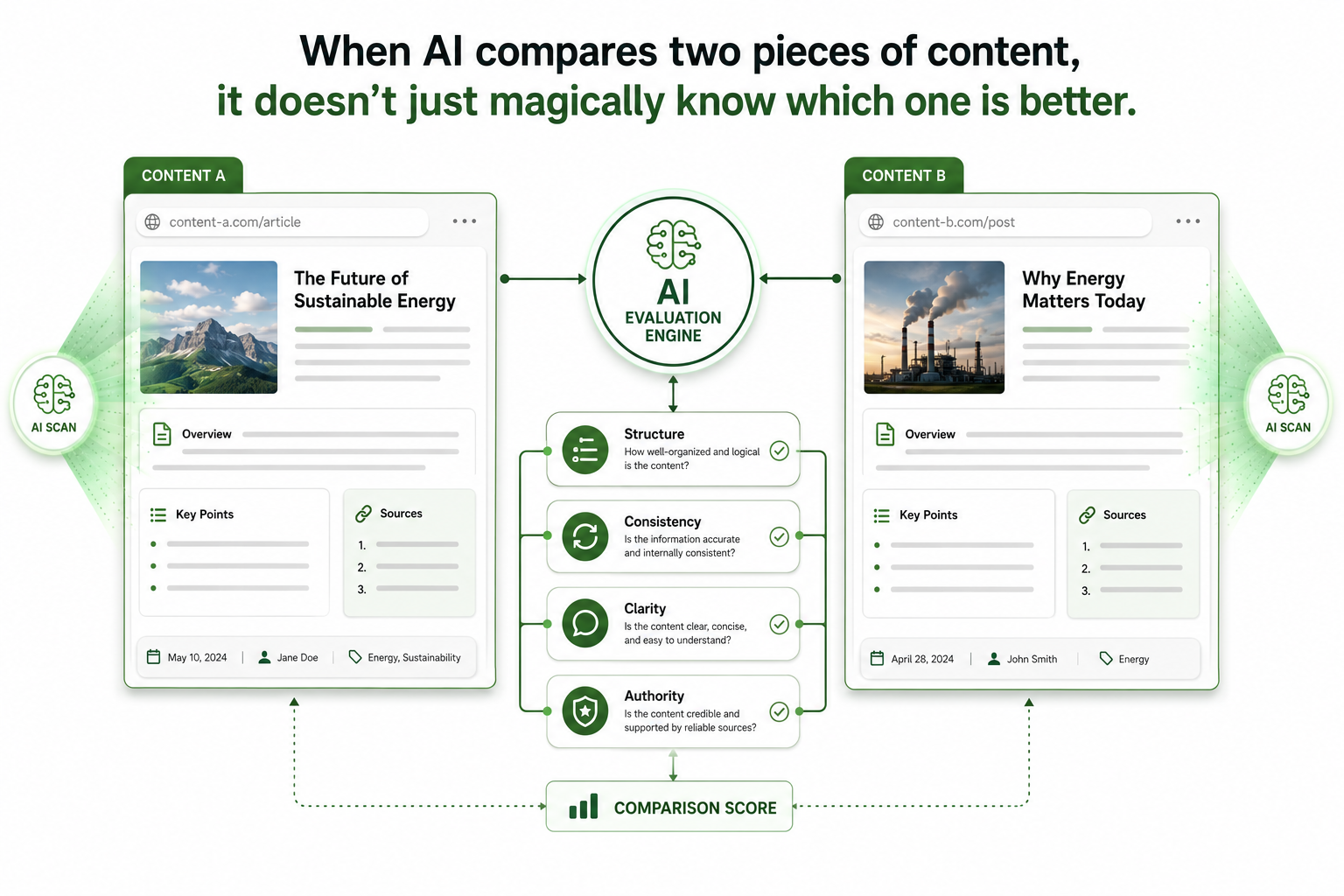
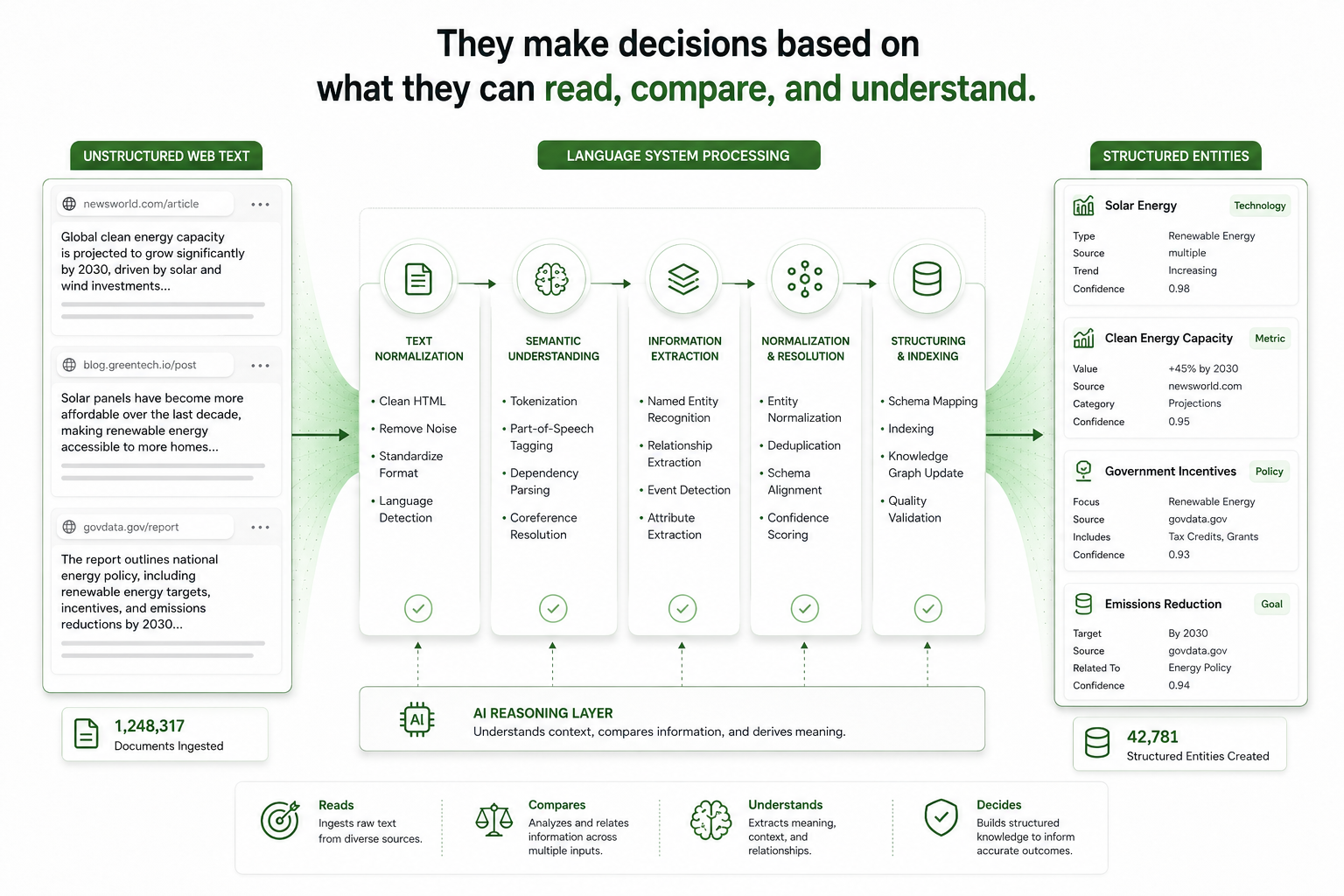
AI systems do not evaluate a company the same way a human buyer does. They read what is available. They compare language, structure, proof, relationships, citations, entities, and source consistency.
If those signals are weak or messy, AI may draw the wrong conclusion.
What Is a Ranking Blind Spot?
A Ranking Blind Spot is a weakness in how an AI-based ranking or comparison system evaluates information.
In plain English:
AI can only judge what it can read, understand, and compare.
That means the system may miss important real-world credibility if that credibility is not clearly represented online.
A company may have:
- Strong client results
- Real expertise
- Years of experience
- Great reviews
- A better team
- Better service
- Better outcomes
But if those signals are not visible, structured, and consistent, AI may not fully understand them.
The Two Problems Business Owners Should Understand
Research around LLM-based ranking systems points to two useful concepts: Decision Objective Hijacking and Decision Criteria Hijacking.
Here is what that means in normal business language.
| Concept | Plain-English Meaning | Business Risk |
|---|---|---|
| Decision Objective Hijacking | The AI gets nudged toward optimizing for the wrong goal. | It may favor content that looks more aligned with a prompt instead of content that is actually more useful or credible. |
| Decision Criteria Hijacking | The AI’s comparison standards get distorted. | It may rank the page with cleaner or more forceful signals over the company with better real-world authority. |
This does not mean every AI result is manipulated.
It means AI ranking decisions are influenced by the information and structure available to the system.
That is the part that matters for SEO, AEO, and GEO.
Why This Matters for SEO, AEO, and GEO
Buyers are already using AI to make decisions before they click.
They are asking:
- “Who is the best company for this service?”
- “What are the top providers near me?”
- “What should I compare before hiring someone?”
- “Which company is more credible?”
- “What are the risks?”
- “What is the best option for my situation?”
If your company is not clearly understood by AI, you may not appear in those answers.
If a competitor has a cleaner footprint, AI may select them instead.
That does not always mean they are better.
It may mean they are easier for the machine to understand.
What Most Businesses Are Getting Wrong
Most businesses think AI SEO means publishing more content.
That is usually the wrong move.
AI does not need more average content.
It needs clearer evidence.
The companies that are more likely to win AI visibility are not just writing more. They are building a cleaner machine-readable footprint.
That means:
- Clear service pages
- Strong answer structure
- Specific examples
- Consistent company information
- Real FAQs
- Case studies
- Reviews
- Author and leadership signals
- Schema markup
- Internal linking
- Third-party mentions
- Clean Google Business Profile data
- Consistent LinkedIn, YouTube, and directory profiles
The issue is not volume.
The issue is clarity plus proof.
Winning vs. Losing Signals in AI Search
| Winning Signal | Losing Signal |
|---|---|
| Clear company identity | Vague brand copy |
| Specific service definitions | Generic service language |
| Consistent entity information | Conflicting company details across the web |
| Structured pages with headings and answers | Long walls of text |
| Real reviews and case studies | Unsupported claims |
| Author, founder, and team signals | Anonymous content |
| Schema that supports the page | No structured data or broken schema |
| Third-party validation | Website-only claims |
| Strong internal linking | Isolated pages with no context |
| Clear FAQs and comparisons | Fluff content with no direct answers |
The GreenBanana Signal Cleanup Framework
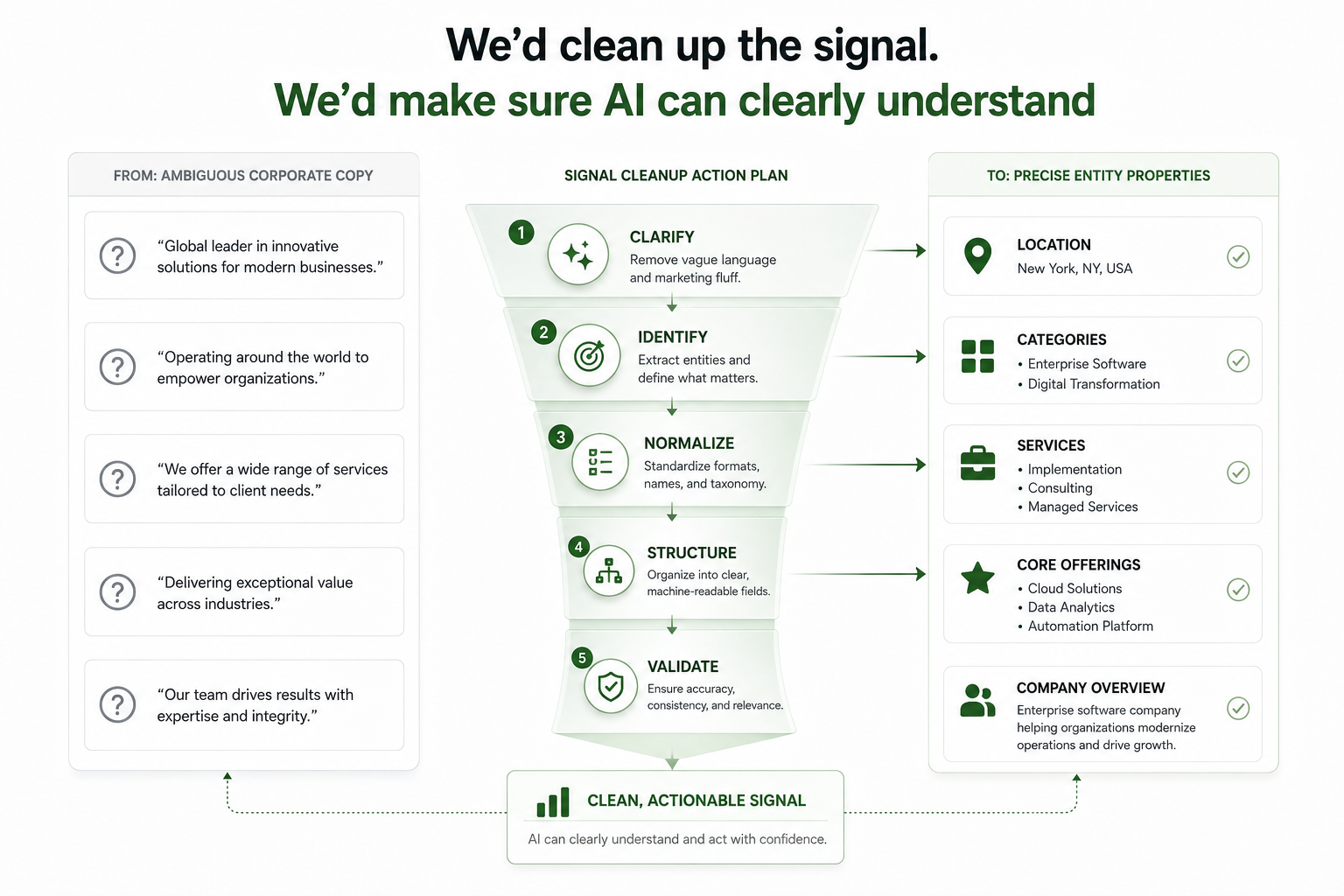
At GreenBanana SEO, we would approach Ranking Blind Spots by cleaning up the signals AI uses to understand the business.
The framework has five parts.
1. Identity: Make the Business Easy to Define
AI needs to know exactly who the company is.
That includes:
- Company name
- Founder or leadership
- Service category
- Locations served
- Core services
- Industries served
- Primary audience
- Differentiators
- Proof points
Bad version:
“We help brands grow with innovative solutions.”
Better version:
“GreenBanana SEO is a Beverly, Massachusetts SEO agency that helps businesses improve visibility in Google Search, Google AI Overviews, AI Mode, ChatGPT, Gemini, Perplexity, and other AI answer engines.”
The second version is easier to understand, extract, and cite.
2. Consistency: Remove Conflicting Signals
AI systems compare information across sources.
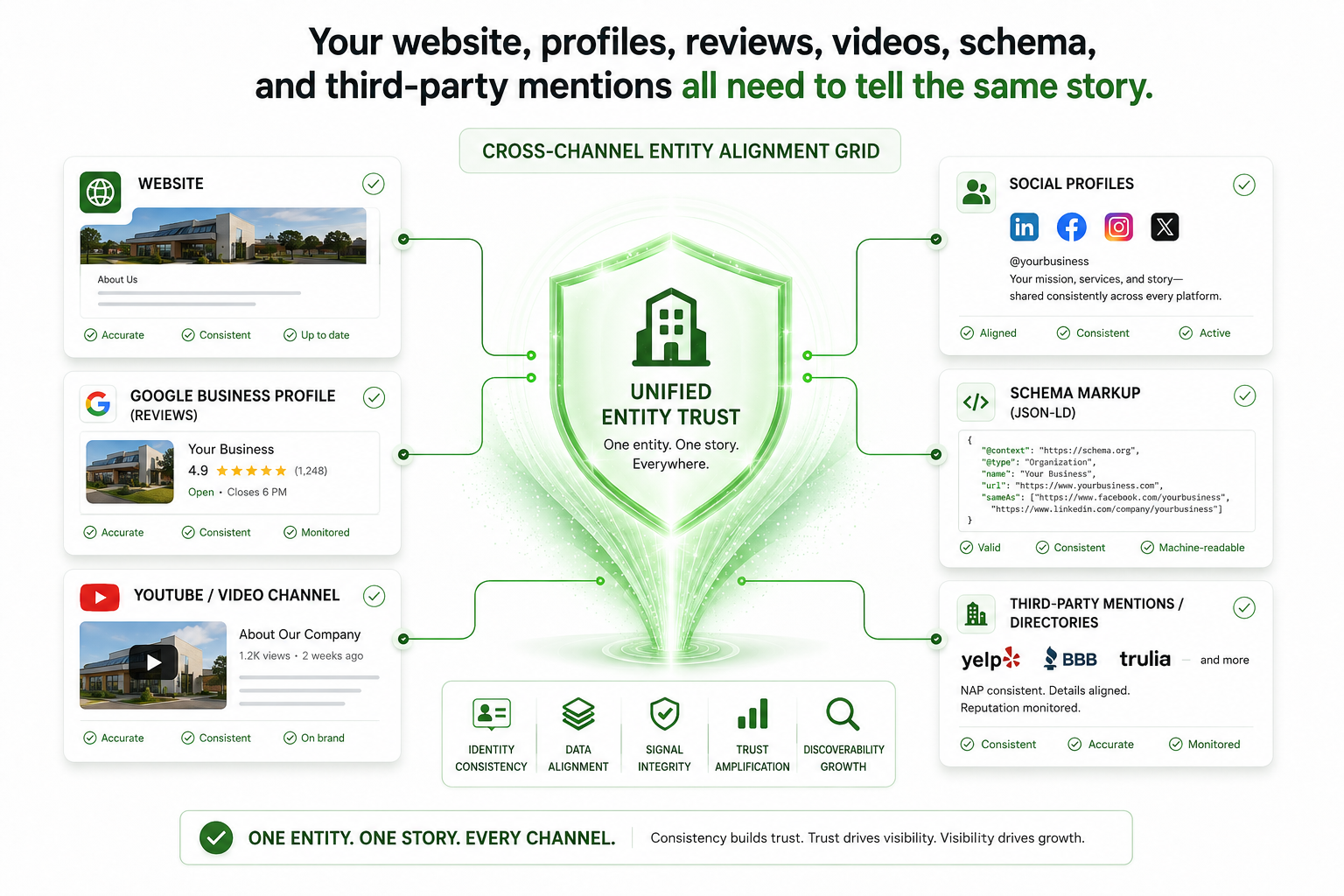
If your website says one thing, your Google Business Profile says another, and your LinkedIn says something else, that creates confusion.
Check consistency across:
- Website
- Google Business Profile
- YouTube
- Review platforms
- Local directories
- Industry profiles
- PR mentions
- Schema markup
- Author bios
- Service pages
The goal is not robotic repetition.
The goal is alignment.
3. Proof: Back Up the Claims
AI systems need evidence.
So do buyers.
Useful proof includes:
- Case studies
- Reviews
- Testimonials
- Awards
- Certifications
- Client examples
- Before-and-after data
- Screenshots
- Industry mentions
- Media features
- Founder expertise
- Team credentials
Weak claim:
“We are experts in AI SEO.”
Stronger claim:
“GreenBanana SEO has been doing SEO since 2009 and now builds AEO and GEO systems focused on Google AI Overviews, AI Mode, ChatGPT, Gemini, Perplexity, Claude, Copilot, entity signals, schema, and AI citation tracking.”
The stronger version gives the system more to work with.
4. Structure: Write So AI Can Extract the Answer
AI systems prefer content they can parse.
That does not mean writing for robots.
It means making the page easier to understand.
Use:
- Clear H2s and H3s
- Short answer blocks
- Definitions
- Comparison tables
- FAQs
- Step-by-step frameworks
- Examples
- Summaries
- Internal links
- Schema markup
- Author bios
- Service-specific proof
Avoid:
- Long intros
- Vague claims
- Dense paragraphs
- Unsupported opinions
- Thin pages
- Recycled content
- Generic “thought leadership”
If the page is hard for a human to scan, it is probably not ideal for AI extraction either.
5. Validation: Get Other Sources to Confirm the Story
Your website matters.
But your website alone is not enough.
AI systems are more likely to trust information when other credible sources confirm it.
Useful validation sources include:
- Reviews
- Client websites
- Podcasts
- YouTube videos
- PR mentions
- Industry directories
- Partner pages
- Guest articles
- Case studies
- Local business profiles
- Award listings
Think of it like a courtroom.
One witness is useful.
Ten aligned witnesses are stronger.
Your website says who you are. Your reviews, schema, videos, profiles, and third-party mentions help confirm it.
What To Do Next
Start with your most important money page.
Then ask these questions:
- Can AI clearly understand who this page is for?
- Does the page directly answer the buyer’s main question?
- Does it include proof, not just claims?
- Does the page connect to supporting content?
- Is the business identity consistent with your profiles, reviews, and schema?
- Are there FAQs, definitions, examples, or comparison sections?
- Could this page be cited as a clean source in an AI answer?
If the answer is no, you do not just have an SEO issue.
You have an understanding issue.
That is fixable.
Key Takeaway
The Ranking Blind Spot is not a trick or loophole. It is a reminder that AI can only rank what it understands. If your business is credible in the real world but vague, inconsistent, or unsupported online, AI may overlook you. The fix is not more content. The fix is clearer signals, stronger proof, better structure, and consistent validation.
Follow-Up Questions
- How do you audit a website for AI search visibility?
- What entity signals matter most for Google AI Overviews and ChatGPT?
- How should service pages be structured for AI citation?
- What schema should a business use for AEO and GEO?
- How do reviews and third-party mentions influence AI trust?
Frequently Asked Questions About AEO
What is AEO?
AEO stands for Answer Engine Optimization. It focuses on making a business, service, or page easier for AI answer systems to understand, compare, summarize, and cite.
How is AEO different from traditional SEO?
Traditional SEO focuses heavily on helping pages rank in search results. AEO adds another layer by helping AI systems understand the page clearly enough to use it as a source in generated answers.
Why would AI choose a weaker competitor?
AI may choose a weaker competitor if that competitor has clearer structure, stronger entity signals, better proof, cleaner schema, or more consistent third-party validation. The competitor may not be better in the real world, but they may be easier for the machine to understand.
What signals help AI understand a business?
Helpful signals include clear service pages, specific examples, real FAQs, reviews, case studies, author signals, schema markup, internal links, Google Business Profile consistency, YouTube content, LinkedIn profiles, and third-party mentions.
Where should a business start with AEO?
Start with the most important money page. Make sure it clearly explains who the page is for, what question it answers, what proof supports the claims, and how it connects to supporting content, profiles, reviews, and schema.
Does AEO mean publishing more content?
Not always. More content is not the answer if the existing content is vague, thin, unsupported, or disconnected. AEO works better when the content is clear, structured, supported by proof, and consistent across the broader entity footprint.
How do Ranking Blind Spots affect AI visibility?
Ranking Blind Spots can cause AI systems to overweight the wrong signals or miss important credibility. When that happens, a business with stronger real-world expertise may be overlooked in favor of a competitor with cleaner machine-readable signals.
Ready to talk AEO?
Start a conversation about your AEO priorities.