AI Credibility Proof: How to Make Your Content Trustworthy Enough for AI Search
What Changed: AI Made Everyone Sound Credible
Traditional SEO rewarded content relevance, backlinks, technical structure, and page quality.
Those still matter.
But AI search has added a new trust layer.
AI engines are not only evaluating whether a page answers a question. They are also trying to determine whether the source is credible enough to summarize, cite, recommend, or use inside an answer.
That shift matters because AI has made polished content easy to produce.
A company can now publish a professional-looking article on almost any topic. The page can have headings, FAQs, examples, diagrams, citations, and a confident tone.
But polished content is not the same as proven expertise.
That creates a major problem for AI systems.
They need to separate real authority from manufactured authority.
 The Brain Surgery Test
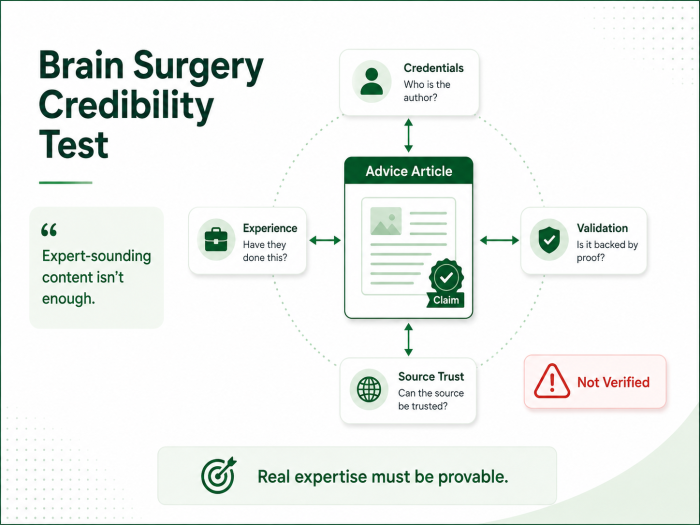
Here is the simplest way to understand AI credibility proof.
Imagine someone publishes a detailed article about a new brain surgery method.
The article looks excellent.
It includes:
- Step-by-step instructions
- Medical language
- Diagrams
- Recovery timelines
- Risk explanations
- Professional formatting
- References
But then ask the obvious questions.
| Credibility Question | Why It Matters |
|---|---|
| Did the author go to medical school? | Establishes baseline qualification |
| Are they a licensed surgeon? | Confirms real-world authority |
| Have they performed this procedure? | Shows practical experience |
| Are they published or cited elsewhere? | Adds external validation |
| Are hospitals, universities, or medical organizations connected to them? | Supports trust beyond the author’s own website |
If the answer to those questions is no, the content may sound impressive, but it is not reliable.
The same principle applies far beyond medicine.
It applies to:
- Financial advisors
- Law firms
- Contractors
- Healthcare providers
- Software companies
- Investment firms
- Consultants
- Agencies
- Manufacturers
- Professional service companies
AI search is moving from “Who wrote the best page?” to “Who can prove they should be believed?”
Why This Matters for AI Citations
A page can rank in Google and still fail to appear in AI answers.
That is because ranking and citation-worthiness are not the same thing.
A traditional SEO page may be strong enough to appear in search results, but too weak to become a source for ChatGPT, Perplexity, Gemini, Claude, Copilot, or Google AI Overviews.
AI engines need confidence.
They may look for signals such as:
- Who wrote the content
- Whether the author is a real person
- Whether the author has relevant expertise
- Whether the company is connected to the topic elsewhere
- Whether other public sources support the claim
- Whether the content is crawlable and structured
- Whether the entity relationships are clear
This does not mean there is one universal AI citation formula.
There is not.
But directionally, unsupported anonymous content is weaker than content surrounded by visible, connected proof.
SEO Content vs. AI-Citable Content
| Traditional SEO Content | AI-Citable Content |
|---|---|
| Targets a keyword | Answers a specific question clearly |
| Optimized for rankings | Structured for extraction and trust |
| May be anonymous | Connected to a real author or reviewer |
| Claims expertise | Shows why the expert is qualified |
| Relies mostly on the website | Builds external corroboration |
| Focuses on content volume | Focuses on credibility systems |
| Uses basic schema, if any | Uses schema to clarify relationships |
| Wins by relevance alone | Wins through relevance plus proof |
This is the part many companies are missing.
They keep producing content, but they do not build the proof structure around the content.
That is why the page may look good to a human but still be weak for AI visibility.
The AI Credibility Proof Framework
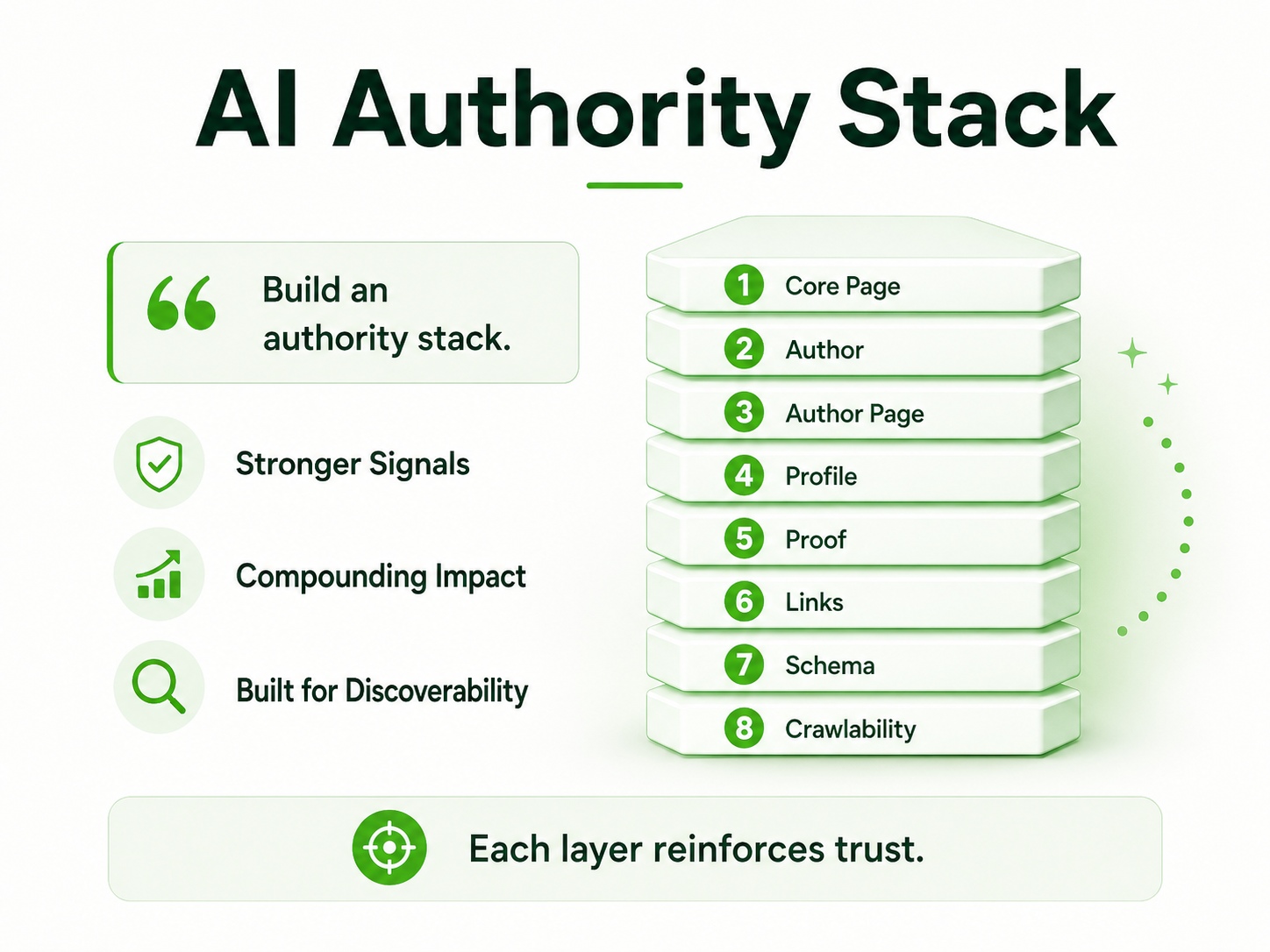
Step 1: Choose the Core Page
Start with the page you want AI engines to trust.
This could be a:
- Service page
- Product page
- Case study
- Industry guide
- Comparison page
- Educational article
- Research page
- Thought leadership asset
The page should be specific.
| Weak Target | Stronger Target |
|---|---|
| Marketing Services | Answer Engine Optimization Services for B2B Companies |
| Roofing | Commercial Roofing Repair for Multi-Location Property Owners |
| Financial Planning | Retirement Planning for High-Net-Worth Business Owners |
| Healthcare Services | Physical Therapy for Post-Surgical Knee Recovery |
Specificity helps AI systems understand what the page should be associated with.
Step 2: Add a Real Author or Expert Reviewer
Anonymous content wastes a credibility opportunity.
The page should clearly identify who wrote, reviewed, or contributed expertise to the content.
Include:
- Name
- Title
- Company role
- Relevant experience
- Specialty areas
- Link to author page
- Link to LinkedIn
- Meaningful credentials or media mentions
The goal is to connect the page to a real-world expert entity.
Step 3: Build a Real Author Page
A strong author page should not be a thin archive page.
It should function as a credibility asset.
Include:
- Professional background
- Years of experience
- Areas of expertise
- Published articles
- Media mentions
- Speaking experience
- Certifications or credentials
- LinkedIn profile
- Company role
- Topics the author is qualified to discuss
This gives search engines and AI systems a deeper proof layer.
Step 4: Connect the Author Page to LinkedIn
LinkedIn can reinforce professional identity.
The author page should link to the LinkedIn profile.
The LinkedIn profile should reflect the same expertise shown on the website.
If the website says the author is an expert in AI SEO, but the LinkedIn profile never mentions AI SEO, the signal is weaker.
Consistency matters.
Step 5: Publish Externally About the Same Topic
The topic should not exist only on your website.
Publish supporting content on:
- Industry publications
- Press release platforms
- Partner websites
- Podcast pages
- Webinar pages
- Trade association pages
- YouTube descriptions
- Case study pages
The goal is to create public associations between the person, company, topic, and core page.
Step 6: Use Third-Party Corroboration
A press release or third-party mention can help when it has a real purpose.
Weak press release:
“We are excited to announce our commitment to excellence.”
Useful press release:
“GreenBanana SEO Publishes New AI Credibility Proof Framework for Companies Trying to Earn AI Search Citations.”
The difference is specificity.
The release should clearly connect:
- The company
- The topic
- The expert
- The resource
- The reason the resource exists
Step 7: Reinforce the Relationships with Schema
Structured data does not create authority by itself.
But it can help clarify relationships.
Useful schema types may include:
- Article schema
- Person schema
- Organization schema
- WebPage schema
- FAQ schema
- Author markup
- SameAs links
- About properties
- Mentions properties
Schema should support the authority that already exists.
It should not be used to pretend a company has credentials it does not have.
Step 8: Make the Proof Crawlable
Authority stacking fails if the proof cannot be discovered.
Review:
- Robots.txt
- LLMs.txt
- Indexability
- Canonical tags
- Internal links
- Page speed
- Rendering issues
- Blocked resources
- Structured data errors
The credibility trail has to be accessible.
If AI crawlers and search engines cannot reach the supporting proof, they cannot use it.
From Weak Page to AI-Citable Asset
| Element | Weak Version | Stronger Version |
|---|---|---|
| Page | Generic service page | Specific guide or service page tied to a real query |
| Author | No author listed | Named expert with role and qualifications |
| Bio | One sentence | Experience, specialty, topic relevance |
| Author Page | Basic archive page | Full credibility page |
| Not connected | Profile reinforces same expertise | |
| External Signal | None | LinkedIn post, PR, podcast, or trade mention |
| Internal Links | Random | Page → author → company → related proof |
| Schema | Missing | Person, Organization, Article, WebPage |
| Crawlability | Unchecked | Indexable, internally linked, accessible |
Why This Is Bigger Than E-E-A-T
Google has talked about experience, expertise, authoritativeness, and trust for years.
AI search makes that concept more urgent.
In traditional Google search, users could review the results themselves.
In AI search, the AI system often acts as the evaluator.
It decides:
- Which sources to use
- Which brands to mention
- Which facts to summarize
- Which links to show
- Which companies to ignore
That means credibility has to be machine-readable.
Your expertise cannot just be implied.
It has to be structured, connected, and reinforced.
What To Do Next
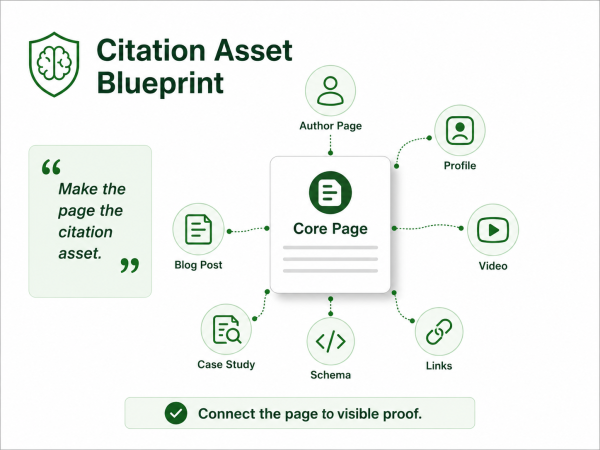
Start with one important page.
Then ask three questions:
- Why is this page useful?
- Why is this author qualified?
- Why should an AI engine trust this source over another source?
If those answers are not obvious, build the authority stack.
Add the author.
Build the author page.
Connect LinkedIn.
Publish externally.
Use schema.
Strengthen internal links.
Make everything crawlable.
Key Takeaway
AI made content easier to create, which made content easier to fake.
That means the next advantage in AI search is not just publishing more content.
It is proving why your content deserves to be trusted.
The companies that win will not only write better answers. They will build clearer credibility trails around those answers.
Follow-Up Questions
- How do you build an author page that helps AI engines understand topical expertise?
- What schema should be used to connect an author, company, and core service page?
- How can LinkedIn support AI visibility and entity credibility?
- What types of third-party mentions are most useful for AI citation strategy?
- How do you audit a page to see if it has enough credibility proof?
Frequently Asked Questions About AI Credibility Proof
How do you build an author page that helps AI engines understand topical expertise?
Build the author page as a credibility asset, not a thin archive page. It should include the author’s professional background, years of experience, areas of expertise, published work, media mentions, speaking experience, credentials, LinkedIn profile, company role, and the topics they are qualified to discuss.
What schema should be used to connect an author, company, and core service page?
Useful schema may include Article, Person, Organization, WebPage, FAQ, author markup, sameAs links, about properties, and mentions properties. The goal is to clarify the relationship between the author, company, topic, and page without adding credentials or authority that do not already exist.
How can LinkedIn support AI visibility and entity credibility?
LinkedIn can reinforce the author’s professional identity outside the company website. The author page should link to the LinkedIn profile, and the LinkedIn profile should support the same expertise shown on the website so the person, company, topic, and experience tell a consistent story.
What types of third-party mentions are most useful for AI citation strategy?
Useful third-party mentions are specific and clearly connected to the topic, expert, company, and resource. Examples include LinkedIn posts, industry publications, press releases, partner websites, podcast pages, webinar pages, trade association pages, YouTube descriptions, and case studies.
How do you audit a page to see if it has enough credibility proof?
Start by asking whether the page is useful, whether the author is qualified, and why an AI engine should trust the source over another source. Then review the authority stack: named author, author page, LinkedIn connection, external proof, schema, internal links, indexability, canonical tags, crawlability, and structured data errors.
Ready to talk AI search visibility?
Contact GreenBanana SEO to discuss your AI search visibility goals.