SEO Knowledge Graphs: How to Make Google and AI Understand, Trust, and Cite Your Brand
An SEO knowledge graph is the connected map of your brand, services, people, locations, content, schema, reviews, and third-party proof. It helps Google and AI systems understand whether your business is real, relevant, and trustworthy. If that map is messy or incomplete, search engines may misunderstand your brand, cite competitors, or leave you out of AI-generated answers.
What Changed?
Search is no longer just about matching a keyword to a page.
That still matters.
But Google, AI Overviews, AI Mode, Gemini, ChatGPT-style answer engines, Perplexity, Claude, and Copilot all need more than keywords. They need to understand the business behind the page.
That means search visibility is shifting from:
| Old SEO Question | New AI Search Question |
|---|---|
| Can this page rank for a keyword? | Does the system understand the brand behind the page? |
| Does the content match the query? | Is the company a trusted entity for this topic? |
| Do we have enough pages? | Are the pages, people, services, reviews, schema, and third-party sources connected? |
| Are we getting traffic? | Are we being cited, summarized, recommended, and described correctly? |
The old SEO game was mostly about pages and rankings.
The new AI search game still includes rankings, but it also requires entity clarity.
In plain English:
Google and AI need to know who you are, what you do, where you do it, what topics you are trusted on, and who else confirms that information.
That is the job of an SEO knowledge graph.
What Is an SEO Knowledge Graph?
An SEO knowledge graph is the structured understanding of your brand and how it connects to other important entities.
It is not one plugin.
It is not just schema.
It is not a single file you upload and forget.
It is the larger map created by your:
- website;
- service pages;
- content;
- internal links;
- structured data;
- Google Business Profile;
- reviews;
- author pages;
- social profiles;
- directories;
- press mentions;
- podcasts;
- YouTube content;
- third-party references.
A knowledge graph helps machines answer basic but important questions.
| Question | Why It Matters |
|---|---|
| Who are you? | Search engines need to identify your brand as a distinct entity. |
| What do you do? | Your services need to be connected to your company. |
| Where do you operate? | Local, regional, national, or industry relevance matters. |
| Who is connected to the brand? | Experts, authors, founders, and team members can support trust. |
| What topics are you trusted on? | Topic authority helps AI systems connect your brand to answers. |
| Who confirms this? | Third-party proof reduces ambiguity. |
The point is confidence.
If Google sees consistent information across your website, schema, Google Business Profile, reviews, directories, articles, and trusted references, it has more confidence that it understands your business.
If those signals are thin, inconsistent, or disconnected, confidence drops.
That is where companies lose visibility.
Why It Matters for AI Search
AI search depends on entity understanding.
Before an AI system can recommend your company, summarize your expertise, cite your website, or include you in an answer, it first has to understand what your brand is and how it fits into the topic.
This is where many companies have a problem.
They have pages.
They have blog posts.
They may even have rankings.
But their brand entity is not clearly connected to the right services, people, locations, topics, reviews, proof, and third-party validation.
That creates a gap between content visibility and brand understanding.
Traditional SEO helps a page rank.
Knowledge graph SEO helps search engines understand the business behind the page.
That distinction matters more now because search results are becoming more answer-driven and entity-driven.
AI systems need sources that appear:
- clear;
- consistent;
- credible;
- connected;
- corroborated.
If your entity signals are weak, you are harder to include.
If your competitors have stronger signals, they are easier to cite.
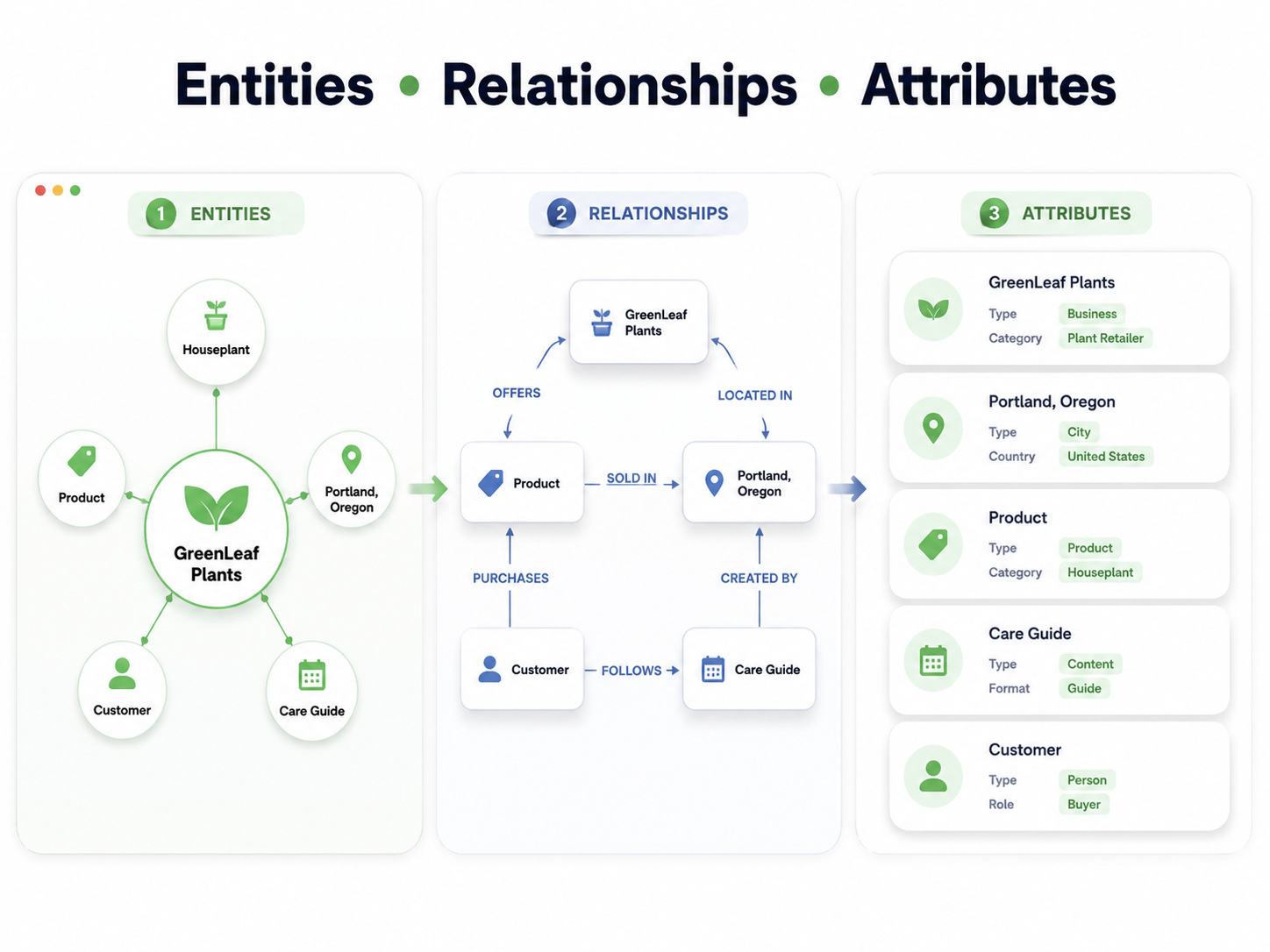
A knowledge graph connects the major signals that help search engines understand a brand.
The Three Building Blocks: Entities, Relationships, and Attributes
You do not need to be a developer to understand this.
You just need to think like a search engine.
1. Entities
An entity is a distinct thing.
For SEO, entities can include:
- your brand;
- people;
- services;
- products;
- locations;
- industries;
- topics;
- credentials;
- publications;
- organizations;
- reviews;
- media mentions.
Example:
GreenBanana SEO is an entity.
Answer Engine Optimization is an entity.
Kevin Roy is an entity.
Boston is an entity.
A service page, author page, case study, and industry topic can all function as related entities.
2. Relationships
Relationships explain how entities connect.
| Entity | Relationship | Entity |
|---|---|---|
| GreenBanana SEO | provides | Answer Engine Optimization |
| GreenBanana SEO | serves | Boston-area businesses |
| Kevin Roy | founder of | GreenBanana SEO |
| Service page | answers | buyer intent |
| Blog post | supports | topic authority |
| Case study | proves | service credibility |
| Review | validates | customer trust |
Search engines are not just reading words.
They are building meaning.
A page that says “AI SEO” twenty times is not automatically strong.
A site that clearly connects AI SEO, AEO, GEO, structured data, author expertise, service pages, reviews, and third-party proof gives machines a better map.
3. Attributes
Attributes are the facts that describe an entity.
For a business, attributes may include:
- official name;
- website URL;
- logo;
- phone number;
- address;
- service categories;
- business description;
- leadership;
- locations;
- social profiles;
- review profiles;
- credentials;
- media mentions.
Attributes help search engines answer:
“Are we sure this is the same business?”
That is why consistency matters.
If your name, phone number, service categories, address, social profiles, and schema are different across the web, you are making the machine work harder.
Harder is not better.
Proof / Breakdown: What Weakens a Brand Knowledge Graph?
Most companies do not have one giant entity problem.
They have a lot of small issues that add up.
| Problem | What It Looks Like | Why It Hurts |
|---|---|---|
| Inconsistent brand information | Different names, old addresses, outdated phone numbers | Creates uncertainty |
| Thin About page | No clear story, leadership, history, or proof | Weakens trust |
| Weak author signals | Content published by “admin” or unnamed contributors | Makes expertise harder to verify |
| Messy service structure | Overlapping pages, buried services, unclear hierarchy | Confuses what the company actually does |
| Missing or bad schema | No Organization schema, wrong sameAs links, outdated info | Creates machine-readable confusion |
| No third-party proof | Only the company’s own site says it is credible | Weakens external validation |
| Disconnected content | Blog posts do not support service pages | Makes topical authority harder to see |
The issue is not that Google is dumb.
The issue is that most websites make Google assemble the puzzle with missing pieces.
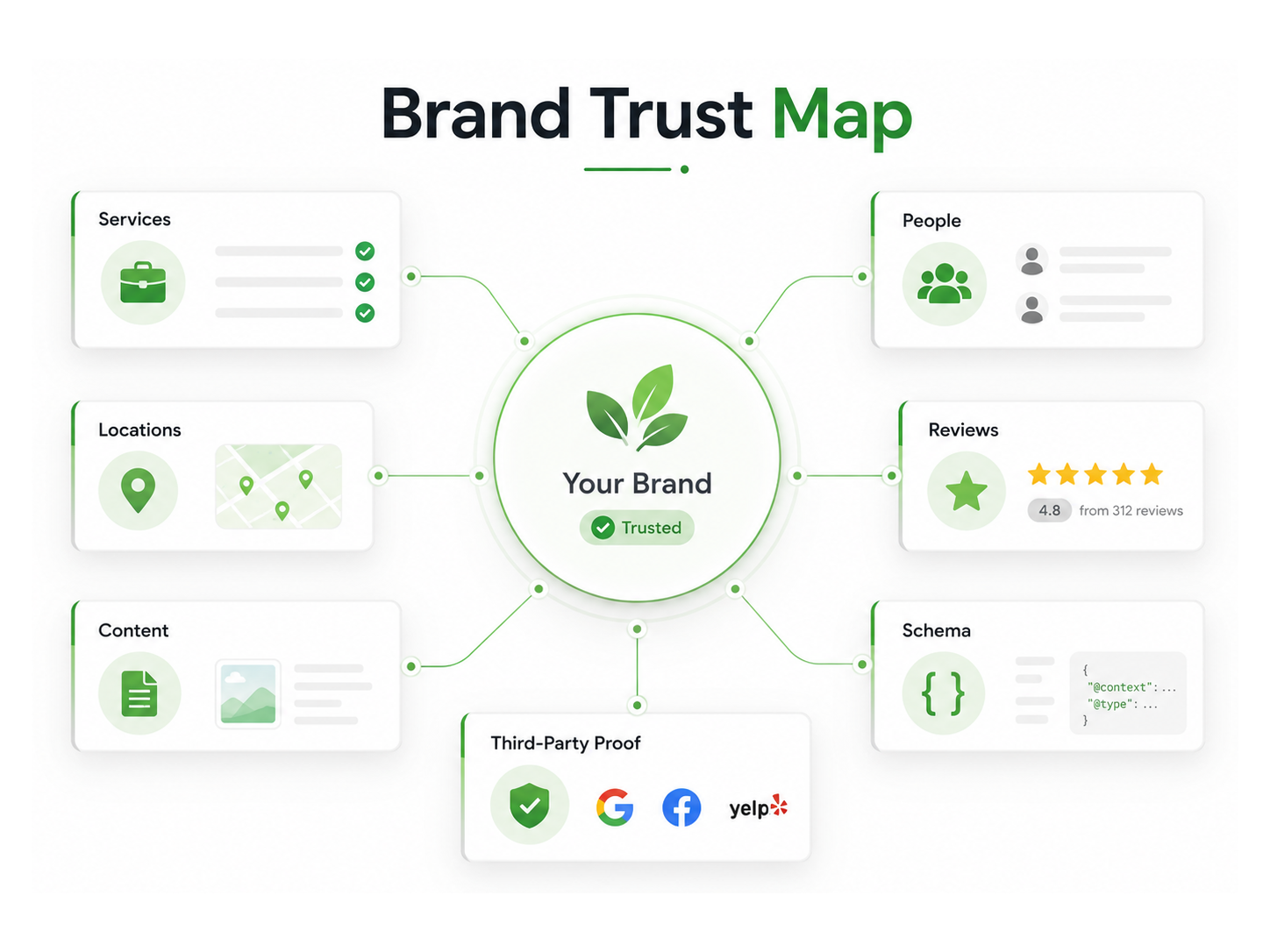
A knowledge graph connects the major signals that help search engines understand a brand.
What Actually Works Now: The SEO Knowledge Graph Framework
Step 1: Audit Your Entity Footprint
Start with what already exists.
Search:
- your brand name;
- brand plus services;
- key people;
- old brand names;
- abbreviations;
- common misspellings;
- service plus location;
- category prompts in AI tools.
Look for:
- wrong descriptions;
- outdated profiles;
- duplicate listings;
- missing social profiles;
- incorrect addresses;
- weak branded results;
- AI answers that ignore your company;
- competitors appearing for your branded concepts.
You cannot fix what you have not mapped.
Step 2: Define Your Core Entities
Decide what your brand should be clearly connected to.
For most companies, this includes:
- brand;
- founders;
- leadership;
- experts;
- services;
- products;
- locations;
- industries;
- customer types;
- content topics;
- proof assets.
This is not keyword research.
This is identity mapping.
You are deciding what your brand should mean to search engines and AI systems.
Step 3: Map the Relationships
Once the entities are defined, connect them.
Examples:
- services connect to buyer problems;
- services connect to commercial pages;
- blog posts connect to service pages;
- authors connect to expertise;
- locations connect to service areas;
- case studies connect to proof;
- reviews connect to trust;
- FAQs connect to buyer questions;
- third-party mentions connect to authority.
This is how your website becomes a system instead of a pile of pages.
Step 4: Strengthen On-Site Signals
Your website is the foundation.
Improve:
- homepage clarity;
- service page structure;
- About page content;
- author pages;
- FAQ sections;
- internal linking;
- location pages;
- topic clusters;
- headings and titles;
- page purpose;
- case study connections.
The mistake most companies make is publishing content without connecting it back to the business.
A blog post should not just exist.
It should reinforce a topic, support a service, connect to an expert, and help prove authority.
Step 5: Clean Up Structured Data
Schema should support the truth.
That may include:
- Organization schema;
- LocalBusiness schema, where relevant;
- Person schema;
- ProfilePage schema;
- FAQPage schema, where appropriate;
- sameAs references;
- logo and official URL references;
- accurate social profile links.
Do not add schema just to add schema.
Bad schema can create more confusion.
Clean schema clarifies what is already visible on the page.
Step 6: Build Third-Party Confirmation
Your website is one witness.
Search engines want multiple witnesses.
Useful third-party confirmation may include:
- Google Business Profile;
- review platforms;
- local directories;
- industry directories;
- social profiles;
- press mentions;
- podcast appearances;
- YouTube videos;
- partner pages;
- trade association profiles;
- credible articles.
This is where SEO starts to overlap with PR and reputation.
That is not a problem.
That is where AI search is going.
Step 7: Monitor Search and AI Visibility
Knowledge graph SEO is not one-and-done.
Track:
- branded search results;
- knowledge panel accuracy, if applicable;
- AI mentions;
- AI citations;
- competitor mentions;
- entity associations;
- third-party descriptions;
- service/topic connections;
- inaccurate AI descriptions;
- missing citations.
The goal is simple:
Is your brand becoming easier to understand, easier to verify, and easier to cite?
Key Takeaway
Knowledge graph SEO matters because AI search needs to understand the business behind the page.
Keywords still matter.
Rankings still matter.
Content still matters.
But if your brand entity is messy, thin, or disconnected, AI systems may not trust you enough to cite or recommend you.
The new SEO question is not only:
“Can this page rank?”
It is also:
“Does Google understand and trust this brand?”
If the answer is no, your knowledge graph needs work.
Frequently Asked Questions About AEO
What is an SEO knowledge graph?
An SEO knowledge graph is the connected map of your brand, services, people, locations, content, schema, reviews, and third-party proof that helps search engines and AI systems understand your business.
Is a knowledge graph the same as schema?
No. Schema is one support layer. A knowledge graph is the larger entity map created by your website, content, structured data, internal links, profiles, reviews, citations, and third-party sources.
How does knowledge graph SEO help AI visibility?
It helps AI systems understand who your brand is, what topics you are relevant to, what services you offer, and whether outside sources confirm your credibility.
What are the biggest signs of a weak knowledge graph?
Common signs include inconsistent business information, weak About pages, missing author signals, messy service structure, bad schema, disconnected content, and limited third-party validation.
What should I fix first?
Start by auditing your brand entity footprint. Search your brand, services, people, locations, and AI prompts. Identify what is missing, wrong, outdated, or inconsistent before building new content.
Ready to talk AEO?
Contact GreenBanana SEO to start a conversation about your AI search visibility.