What Are the 3 Headings AI Engines Extract First?
Author: Kevin C. Roy · GreenBanana SEO · Published: 2026-02-05
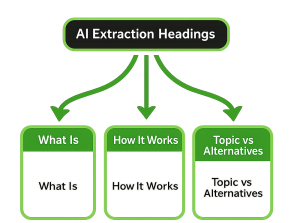
AI engines like ChatGPT, Gemini, and Perplexity don’t read pages top-to-bottom; they extract key sections to assemble answers. To earn AI citations, your page structure must prioritize extraction. The three headings AI looks for first are a direct-answer H2, a “How it Works” H2, and a comparison/decision H2. Fixing these headings is the fastest way to improve your AI visibility.
Jump to a section:

It’s February 2026—here’s what just changed in AI search that you should know about.
AI engines don’t read your page like a human. They extract specific sections, then assemble an answer from what they can quickly understand. That’s exactly why some pages rank well in traditional search but never get cited in Generative Engine platforms. Their page structure makes the best content invisible to machines.
This companion post breaks down the highlight reel: the three specific headings AI engines grab first, what those headings signal to the algorithm, and how to fix your site’s structure without having to rewrite your entire content library.
Core Highlights and Takeaways
Here are the five moments that matter most when optimizing for AI, mapped directly to how these systems choose what to cite.
- AI engines don’t read top-to-bottom. They extract specific chunks. If your best information is buried, it won’t be seen.
- Heading #1 is the first H2 that directly answers the query. It should not be your brand story. It needs to be a clear, definition-style answer block.
- Heading #2 is the “How it works” / process breakdown. AI looks for step-by-step logic that is bullet-friendly and explains cause and effect.
- Heading #3 is the comparison / decision heading. Formats like “X vs Y” or “When to use A vs B” are where judgment questions get answered—and where citations are earned.
- Clarity beats clever. If a human has to read the heading twice to understand the context, the AI has already skipped it.
The takeaway pattern: Each of these headings makes your page extractable. AI engines demand content they can reuse without heavy interpretation. Rankings do not equal citations. If your structure isn’t extraction-friendly, you can rank organically but still remain completely invisible inside AI answers.
Mapping Highlights to Action
| Highlight | What It Signals | Why It Matters | What To Do Now |
|---|---|---|---|
| AI extracts sections (doesn’t read top-to-bottom) | Extraction-first parsing | If your best info is buried, it won’t be reused | Audit headings and move answers into extractable sections |
| First H2 directly answers the query | Definition/anchor chunk | This is often the summarization source | Make H2: “What Is [Topic]?” and answer in 2–4 sentences |
| “How it works” / process breakdown | Mechanism + step logic | Feeds secondary prompts and follow-up questions | Add H2: “How [Topic] Works” with bullets + cause → effect |
| Comparison / decision heading | Judgment & distinctions | Citations spike where AI must decide | Add H2: “[Topic] vs Alternatives” (or “When to use A vs B”) |
| Simple 3-H2 formula beats tools | Repeatable structure | Most “AI visibility” problems are structural | Apply the H1 → What Is → How It Works → Vs Alternatives pattern |
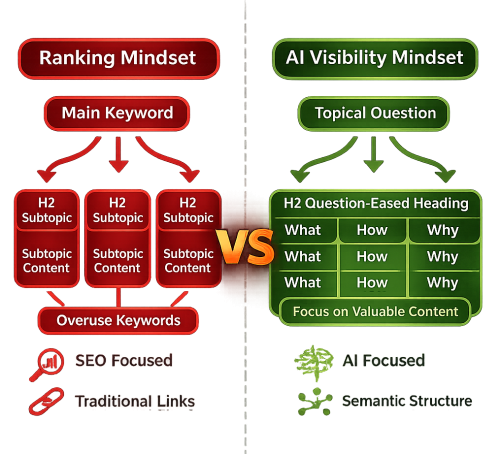
Ranking Mindset vs AI Visibility Mindset
| Ranking Mindset | AI Visibility Mindset |
|---|---|
| Long intros and brand narrative up front | Immediate definition under the first H2 |
| Creative headings (“Why this matters,” “Understanding…”) | Literal headings (“What is…”, “How it works…”, “X vs Y”) |
| Assumes the reader follows the whole page | Assumes the engine extracts only a few chunks |
| Content quality as the primary lever | Structure + extractability as the primary lever |
| Explains benefits broadly | Helps the engine decide (comparisons & distinctions) |
AI Citation Readiness Checklist
- H1 states the main topic clearly (no cleverness).
- Your first H2 is “What Is [Topic]?” (or equivalent) and answers directly in 2–4 sentences.
- You include an H2 for “How [Topic] Works” with bullets or step logic.
- You include an H2 for comparison/decision (e.g., “[Topic] vs Alternatives”).
- Headings avoid vague marketing language (“Why it matters,” “Introduction,” “Understanding…”).
- Answers aren’t buried under nested H4s; key sections are easy to extract.
- Each H2 announces exactly what the section contains so AI can reuse it confidently.
The Simple Page Formula
This is the structure demonstrated in the video. The gold formula fixes more AI visibility issues than most complex tools simply by shifting to extraction-friendly architecture:
- H1: Main Topic
- H2: What Is [Topic]?
- H2: How [Topic] Works
- H2: [Topic] vs Alternatives
Common Extraction Mistakes
If your content ranks well but lacks AI citations, you likely have a structural issue. Avoid these common mistakes that break extraction:
- Using clever or vague headings that require context to interpret.
- Relying on marketing language instead of literal, descriptive labels.
- Burying the “real answers” deep inside nested H4s or heavy paragraphs.
Watch the Video Breakdown
If you want the full walkthrough and live examples, watch Video 19 below:
Frequently Asked Questions
Why don’t AI engines read my page top to bottom?
AI systems often extract a handful of high-signal sections instead of consuming the full page in order. They prioritize chunks that are easy to interpret and reuse. If your answers are buried, they get skipped.
What is the most important heading for AI citations?
The first H2 that directly answers the query is the biggest lever. It should behave like a definition block and appear early. That first clear answer is often what gets summarized and reused.
Should my intro be the place where I answer the question?
Not if you want consistent extraction. Your intro is for humans, but AI tends to look for labeled answer sections. Put the direct answer under a clear H2 instead of burying it in the lede.
What should my first H2 look like?
Use a literal heading that matches the intent, like “What Is [Topic]?” Avoid vague titles like “Introduction” or “Why [Topic] Matters.” Then answer in 2–4 direct sentences.
Why does a “How it works” section matter to AI?
AI doesn’t just want a definition—it wants the mechanism. Process sections feed follow-up prompts and secondary questions. Bullet-friendly logic and cause → effect make reuse easier.
Why do comparisons generate more citations?
AI engines often answer judgment questions, and comparisons help them decide. Distinctions like “X vs Y” or “When to use A vs B” are citation magnets. If your page helps the engine decide, it’s more likely to quote you.
What breaks AI extraction the fastest?
Clever, vague headings and marketing language are the biggest culprits. Another common issue is burying the real answers under nested H4s. If the heading doesn’t announce the answer clearly, AI skips it.
What is the simplest heading structure that improves AI visibility?
Use this sequence: H1 main topic, then H2 “What Is [Topic]?”, H2 “How [Topic] Works”, and H2 “[Topic] vs Alternatives.” This structure alone fixes many AI visibility issues because it’s extraction-friendly.
If my content ranks, why isn’t it being cited by AI?
Because rankings and citations aren’t the same problem. You can rank with long-form content that humans love, but AI needs clean, labeled chunks it can reuse. Most citation gaps are structural, not “content quality” issues.
Do I need to rewrite my whole page to fix this?
No—start with the three headings AI extracts first. Add a direct-answer first H2, a “How it works” H2, and a comparison H2. Often you’re reorganizing and relabeling more than rewriting.
Ready to talk through your AI search strategy?
Contact GreenBanana SEO to discuss how your content can be structured for search engines and AI-driven discovery.