


An AI SEO Agency Scorecard helps you evaluate whether an agency can make your brand visible, cited, accurate, and trusted inside AI-generated answers. It looks beyond rankings to measure AI answer presence, citations, prominence, accuracy, topic coverage, entity strength, share of voice, and business impact.
Introduction: You Need a New Scorecard for AI SEO
For years, evaluating an SEO agency was pretty straightforward.
You looked at rankings, traffic, keyword movement, backlinks, technical fixes, and maybe conversions.
Those things still matter.
But they do not show the full picture anymore.
AI search is changing how buyers discover companies. People now ask ChatGPT, Gemini, Perplexity, Claude, Google AI Overviews, and other answer engines for recommendations, comparisons, summaries, and shortlists.
That means your agency cannot only be judged by whether it can rank a page.
The better question is:
Can this agency make our brand visible, cited, accurate, and trusted inside AI-generated answers?
That is where an AI SEO Agency Scorecard comes in.
It gives business owners, CMOs, and marketing teams a practical way to evaluate whether an agency is actually prepared for AI search visibility, not just traditional blue-link SEO.
What Is an AI SEO Agency Scorecard?
AI SEO Agency Scorecard Definition
An AI SEO Agency Scorecard is a structured evaluation framework used to judge whether an SEO agency can help your brand appear, get cited, and be represented correctly across AI-powered search experiences.
It is not just a checklist of SEO tasks.
It is a way to measure whether an agency understands the new visibility layer created by AI answers, AI summaries, citations, entity signals, and AI-generated recommendations.
A good scorecard helps you evaluate whether an agency can answer questions like:
- Can they track whether our brand appears in AI answers?
- Can they measure when competitors are recommended instead?
- Can they improve our chances of being cited?
- Can they fix inaccurate AI descriptions of our brand?
- Can they build content that AI systems can understand and use?
- Can they connect AI visibility to business outcomes?
In plain English, it helps you separate a traditional SEO agency from an agency that understands AI SEO, AEO, and GEO.
Why the Old SEO Agency Scorecard Is Incomplete
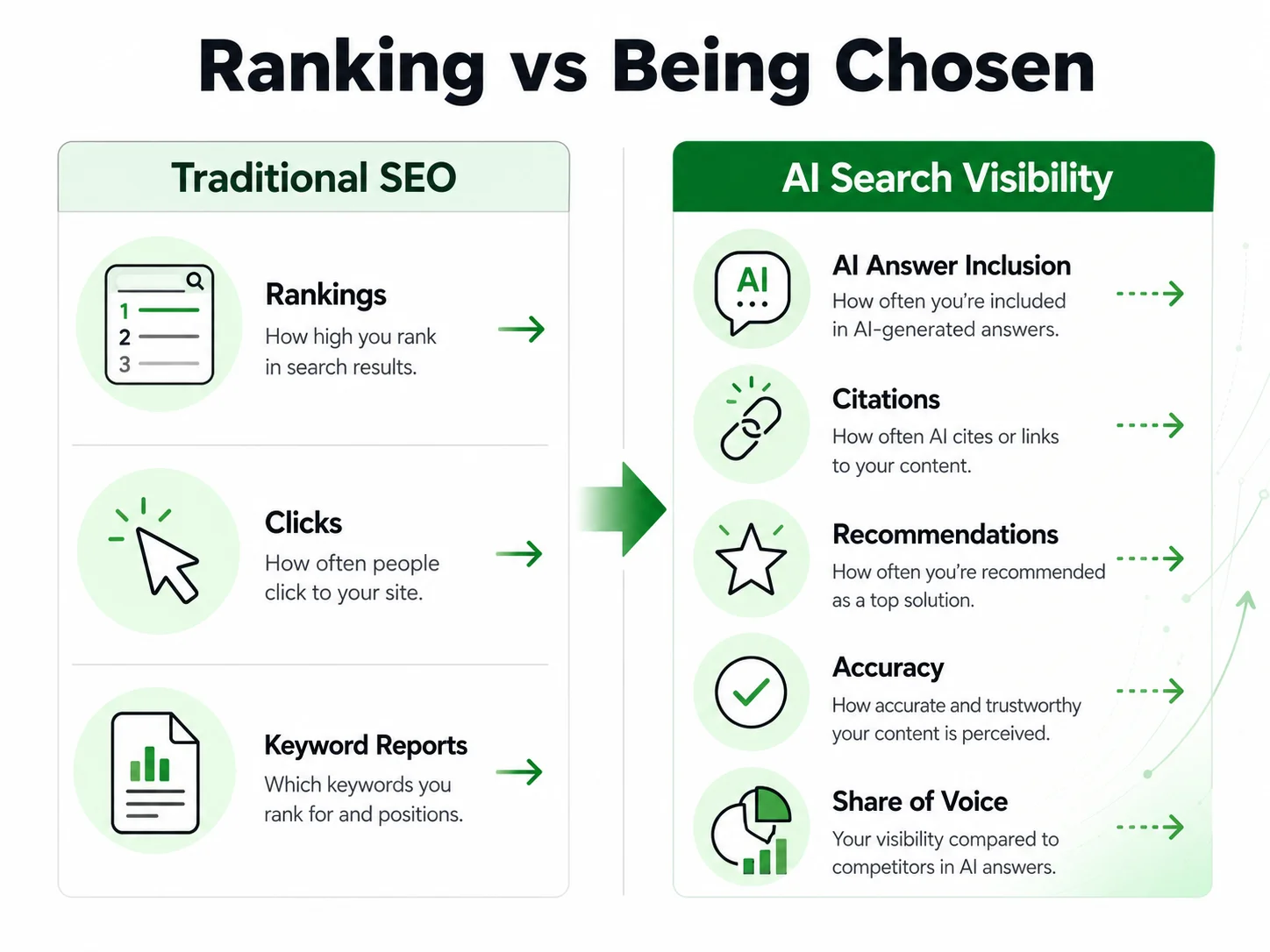
The old SEO scorecard usually looked at rankings, backlinks, organic sessions, technical issues, and keyword reports.
That is still useful.
But it is incomplete in an AI search environment.
A company can rank well and still be missing from AI-generated answers. A page can get impressions but lose clicks because the AI summary already satisfied the user’s intent. A brand can be mentioned by AI but not cited. Or worse, the AI answer can describe the company incorrectly.
That means classic SEO metrics can look healthy while the brand is quietly losing influence at the answer layer.
An agency that only reports rankings may miss the bigger issue:
The buyer already got a recommendation before they ever clicked a website.
What the Scorecard Should Help You Decide
An AI SEO Agency Scorecard should help you evaluate the agency’s strategy, execution, and measurement maturity.
It should tell you whether the agency can:
- Build prompt sets around real buyer questions
- Track AI answer presence
- Measure citations and mentions
- Benchmark competitors
- Improve topical authority
- Strengthen entity signals
- Fix technical barriers
- Create source-worthy content
- Monitor brand accuracy
- Report on meaningful movement over time
The goal is not to make agency selection complicated.
The goal is to ask better questions before you hire, renew, or expand a relationship.
Who Should Use This Scorecard
This scorecard is useful for:
- Business owners evaluating an AI SEO agency
- CMOs comparing SEO proposals
- Marketing directors trying to understand AI search
- SEO leads auditing current agency performance
- Digital teams reviewing AEO or GEO vendors
- Companies that already rank but are unsure whether they appear in AI answers
If your buyers are using AI engines to research your category, you need a better way to evaluate the agency responsible for search visibility.
The Core Problem: Ranking Is Not the Same as Being Chosen
AI Search Changes the Buyer Journey
Traditional search was built around a simple journey:
Search, scan, click, compare.
AI search compresses that journey.
Now a buyer can ask an AI engine:
- “Best AI SEO agencies”
- “Top agencies for answer engine optimization”
- “Who should I hire for AI search visibility?”
- “What is the best SEO agency for getting cited in ChatGPT?”
- “Which companies specialize in AEO and GEO?”
Instead of browsing ten links, the buyer may get a short answer, a list of recommended providers, a comparison, and a few citations.
That means the agency’s job is not only to help you rank.
The agency’s job is to help you become part of the answer.
The Invisible Loss Problem
This is where companies get surprised.
The traditional SEO dashboard can still look fine.
Rankings may hold steady. Impressions may increase. Technical scores may look clean. Keyword footprint may remain strong.
But AI-generated answers may be recommending competitors instead.
That is the invisible loss problem.
Your SEO reports may show that you are still visible in search, while AI answers are shaping buyer decisions without you.
That gap is exactly why AI visibility needs a separate scorecard.
AI Visibility Requires Inclusion, Prominence, and Trust
AI visibility is not binary.
It is not just “Are we there or not?”
You need to know:
- Are we included?
- Are we cited?
- Are we a top recommendation?
- Are we described correctly?
- Are competitors positioned better?
- Are we trusted as a source?
- Are we visible across the full topic universe?
Being mentioned once is not enough.
A strong agency should understand the difference between weak inclusion, strong prominence, trusted citation, and accurate representation.
Why Agencies Need a Different Measurement Model
An agency that only measures rankings is measuring the old layer of search.
An agency that understands AI search visibility measures the answer layer too.
That means the agency should be able to track how the brand appears in AI-generated summaries, answer engines, citations, shortlists, entity results, and competitive recommendations.
The goal is not to replace SEO reporting.
The goal is to expand it.
Request an AI Visibility Audit
* Required fields
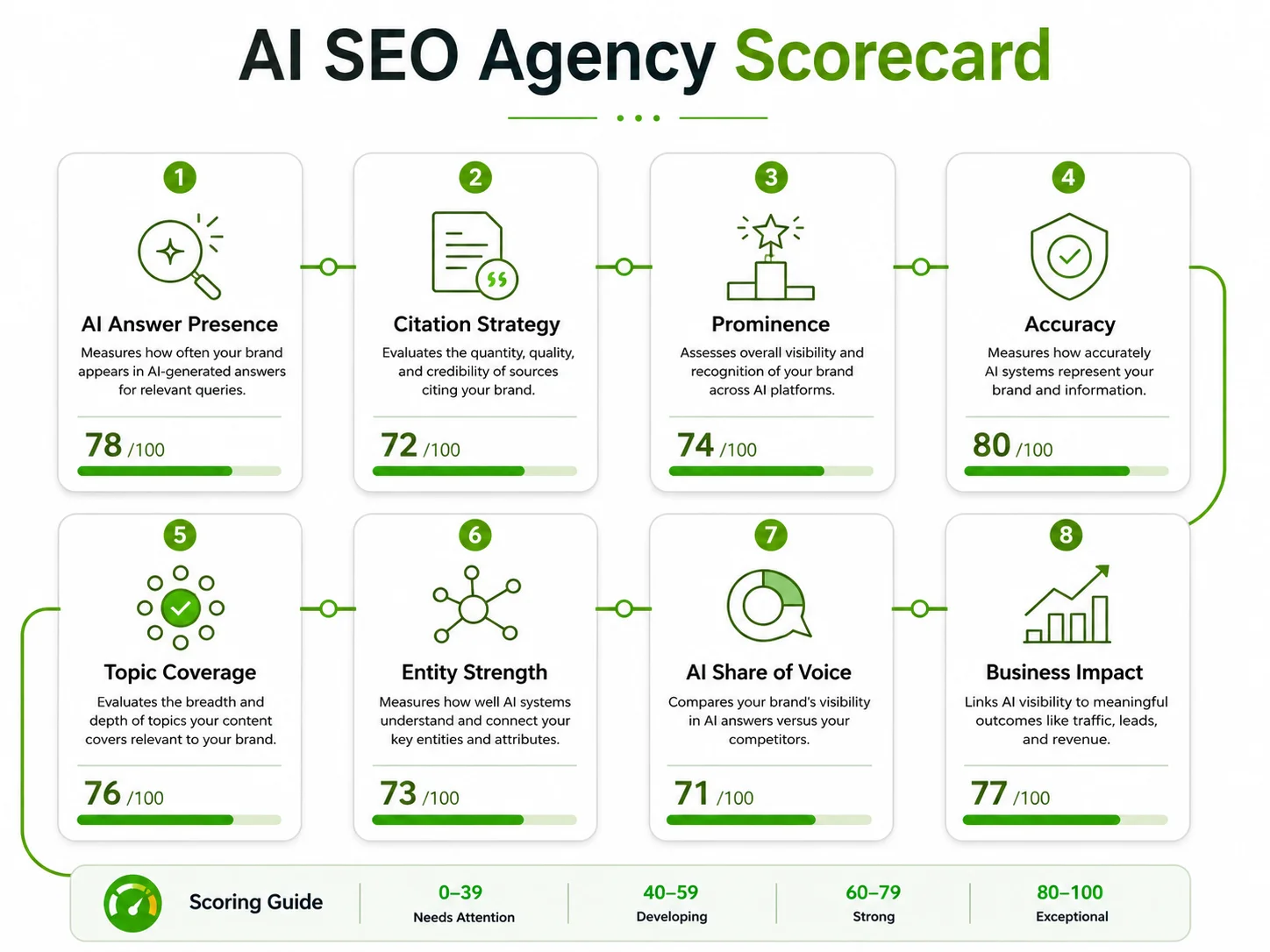
The AI SEO Agency Scorecard Categories
1. AI Answer Presence
AI answer presence measures whether your brand appears in AI-generated answers for the prompts, topics, and buyer questions that matter.
This is the entry point.
If the buyer asks about your category and your brand is missing, you are not in the decision set.
A strong agency should be able to show how often your brand appears across priority prompts, including:
- Informational prompts
- Comparison prompts
- “Best agency” prompts
- Branded prompts
- Competitor alternative prompts
- Service-specific prompts
- Buyer decision prompts
The agency should not just test random prompts. It should build a prompt set based on real buyer intent.
2. Citation and Attribution Strategy
A mention is useful.
A citation is stronger.
Citation strategy measures whether AI engines are using your website, URLs, or content assets as sources.
A strong agency should know how to evaluate:
- Which pages are cited
- Whether the right pages are cited
- Whether competitors are cited instead
- Whether third-party sources are influencing AI answers
- Whether your content is source-worthy
- Whether your site architecture helps AI engines find the right page
The key question is simple:
Is your brand being treated as a source of truth, or just a name in the mix?
3. Prominence and Recommendation Quality
Not all AI mentions are equal.
An agency should track whether your brand is a top recommendation, a shortlist item, a buried mention, or a weak afterthought.
Prominence matters because users often skim AI answers.
If your competitor appears first and your brand appears fifth, the experience is not equal.
A strong agency should measure:
- First mention position
- Top three placement
- “Best for” positioning
- Shortlist inclusion
- Positive, neutral, or negative framing
- Whether your brand is recommended or simply listed
In AI search, attention is limited.
Prominence is part of performance.
4. Representation Accuracy
This is one of the most important categories.
Representation accuracy measures whether AI engines describe your brand correctly.
AI answers may simplify, compress, or misstate information about your company.
That can include:
- Wrong pricing
- Wrong services
- Wrong location
- Wrong target audience
- Missing differentiators
- Outdated capabilities
- Incorrect comparisons
- Confusing you with competitors
A strong agency should be able to identify these issues and create a plan to fix the source signals that may be causing them.
High visibility with bad accuracy can hurt trust.
5. Topic Coverage and Content Depth
AI systems need consistent evidence that your brand belongs in a topic.
One page is rarely enough.
A strong agency should know how to build topic coverage across:
- Definitions
- How-to content
- Service pages
- Comparison pages
- Use-case pages
- Industry pages
- FAQs
- Buyer guides
- Technical explainers
- Thought leadership
The goal is to make your brand visible across the full topic universe, not just one keyword.
That is how a brand becomes more stable in AI-generated answers.
6. Entity Strength and Brand Consistency
AI systems need to understand your brand as an entity.
That means they need to know who you are, what you do, what you offer, where you operate, who you serve, and how the broader web describes you.
A strong agency should understand:
- Organization schema
- Author signals
- Brand facts
- Service descriptions
- Internal linking
- Consistent naming
- Third-party references
- Review and directory consistency
- Knowledge graph signals
- Entity relationships
If your brand is described inconsistently across the web, AI engines may hesitate, misrepresent you, or cite safer sources.
7. Competitive AI Share of Voice
You should never evaluate AI visibility in isolation.
The real question is:
Who is being recommended instead of you?
AI share of voice measures how often your brand appears compared to competitors inside AI-generated answers.
A strong agency should be able to track:
- Which competitors appear most often
- Which competitors are cited
- Which competitors are recommended first
- Which topics competitors own
- Which sources support competitor visibility
- Where your brand has displacement opportunities
This turns AI SEO from a vague visibility project into competitive intelligence.
8. Conversion and Business Impact Signals
AI visibility should connect to business outcomes where possible.
Not every AI interaction produces a direct click. But a strong agency should still look for downstream indicators.
These may include:
- Branded search lift
- Direct traffic changes
- AI referral traffic
- Assisted conversions
- Demo or contact form trends
- Sales team feedback
- Lead quality signals
- Increased visibility for BOFU prompts
- Better appearance in comparison answers
The agency should not pretend every AI mention can be tied perfectly to revenue.
But it should understand how AI visibility may influence demand, shortlists, and pipeline.
How to Score an AI SEO Agency
Use a 0–5 Scoring System
Keep the scorecard simple.
For each category, score the agency from 0 to 5.
| Score | Meaning |
|---|---|
| 0 | No clear capability |
| 1 | Basic awareness, no process |
| 2 | Some process, limited execution |
| 3 | Competent but incomplete |
| 4 | Strong, repeatable approach |
| 5 | Advanced, measurable, and actionable |
The point is not to create a perfect mathematical model.
The point is to create a consistent way to compare agencies.
Recommended Scorecard Weighting
Not every category should carry the same weight.
A practical starting model could look like this:
| Category | Suggested Weight |
|---|---|
| AI Answer Presence | 15% |
| Citation and Attribution Strategy | 15% |
| Prominence and Recommendation Quality | 10% |
| Representation Accuracy | 15% |
| Topic Coverage and Content Depth | 15% |
| Entity Strength and Brand Consistency | 10% |
| Competitive AI Share of Voice | 10% |
| Conversion and Business Impact Signals | 10% |
This weighting gives more emphasis to inclusion, citations, accuracy, and topic coverage because those are foundational to AI visibility.
You can adjust weights based on your business.
For example, a regulated industry may weight accuracy higher. A competitive SaaS company may weight share of voice and BOFU visibility higher.
Score by Prompt Set, Not Just Keywords
Traditional SEO often starts with keywords.
AI SEO should start with prompts.
Prompts reflect how buyers actually ask AI engines for help.
Instead of only tracking “AI SEO agency,” a better prompt might be:
“What is the best AI SEO agency for a company that wants to appear in ChatGPT, Perplexity, and Google AI Overviews?”
A strong agency should build a prompt set that includes:
- Category prompts
- “Best for” prompts
- Comparison prompts
- Pricing prompts
- Service prompts
- Use-case prompts
- Competitor prompts
- Branded prompts
This gives a more realistic view of AI search visibility.
Score Across Funnel Stages
Not all visibility has the same value.
A brand appearing for a general definition prompt is useful.
A brand appearing for a high-intent comparison prompt may be more valuable.
Score across funnel stages:
| Funnel Stage | Example Prompt Type |
|---|---|
| TOFU | “What is AI SEO?” |
| MOFU | “Best AI SEO agencies” |
| BOFU | “GreenBanana SEO vs competitor” |
This prevents an agency from over-crediting itself for low-intent visibility while missing decision-stage searches.
Score Across Search Surfaces
A good agency should not only look at one platform.
AI search visibility can show up across:
- Classic search results
- AI summaries
- AI Overviews
- Chat-based answers
- Conversational follow-ups
- Third-party listicles
- Review sites
- Entity and knowledge layers
- Community discussions
The scorecard should evaluate whether the agency understands this broader discovery ecosystem.
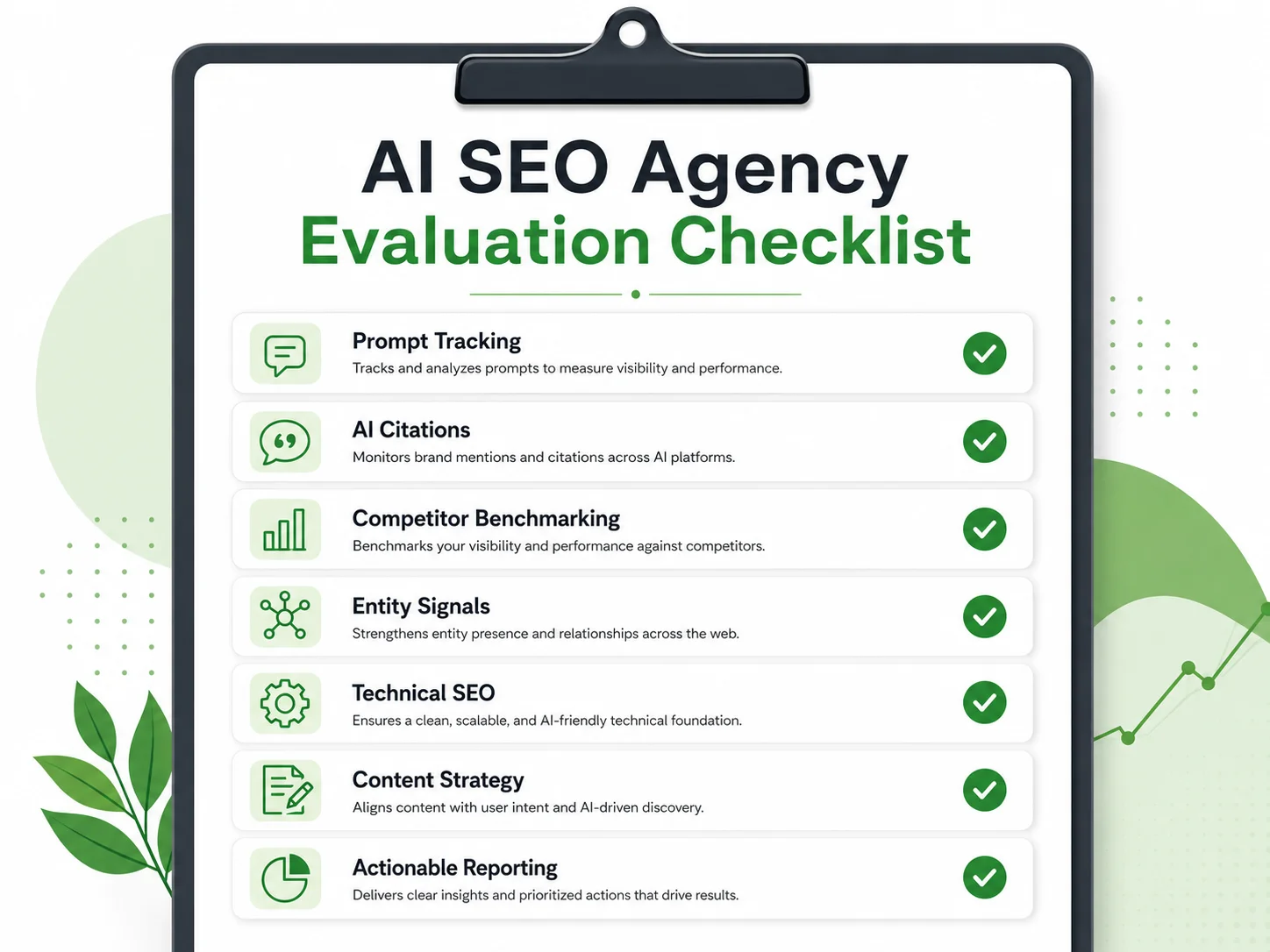
What a Strong AI SEO Agency Should Be Able to Show You
A Clear Baseline Process
A strong agency should start with a baseline.
That baseline should show where your brand currently appears, where it is missing, which competitors show up, and which sources are being cited.
A useful baseline may include:
- Prompt visibility
- AI answer presence
- Citation rate
- Mention rate
- Competitor share
- Accuracy issues
- Platform differences
- Content gaps
- Entity gaps
Without a baseline, the agency cannot prove improvement.
A Repeatable Monitoring Method
One screenshot is not monitoring.
AI answers can change by prompt, platform, location, and time.
A strong agency should have a repeatable monitoring method.
That means:
- Stable prompt sets
- Consistent cadence
- Evidence capture
- Competitor tracking
- Citation tracking
- Trend reporting
- Clear methodology
The agency should be able to explain what is being tracked, how often it is tracked, and how results are interpreted.
A Content Strategy Built for AI Answers
A strong agency should understand how to create AI-ready content.
That means content that is clear, structured, useful, and easy to extract.
Look for an agency that can build:
- Definitions
- FAQs
- Comparison pages
- Use-case pages
- Topic clusters
- “Best for” sections
- Source-worthy guides
- Original frameworks
- Structured service pages
- Clear entity language
The content should help both humans and AI systems understand why your brand belongs in the answer.
Technical and Entity SEO Capability
AI SEO still depends on technical SEO.
A strong agency should understand:
- Crawlability
- Indexation
- Page speed
- JavaScript rendering
- Canonical signals
- Structured data
- Internal linking
- Site architecture
- Schema
- Entity consistency
The agency should also understand how brand facts, author signals, and third-party references support AI understanding.
Technical SEO and entity clarity are not optional.
Competitive Gap Analysis
A strong agency should show you where competitors are winning.
That includes:
- Which competitors appear in AI answers
- Which competitors are cited
- Which pages are cited
- Which third-party sources support them
- Which topics they own
- Which prompts you are missing from
- Where your brand has an opportunity to displace them
This is one of the most useful outputs of an AI SEO program.
You are not guessing what to build next.
The answer layer shows you.
Actionable Reporting
A report should not just say, “Visibility improved.”
It should tell you what to do next.
A strong agency report should create an action backlog.
That backlog may include:
- Pages to create
- Pages to update
- FAQs to add
- Internal links to improve
- Schema to clean up
- Entity signals to clarify
- Third-party mentions to pursue
- Content clusters to expand
- Accuracy issues to fix
If the report does not lead to action, it is not a scorecard.
It is just a dashboard.
Red Flags When Evaluating an AI SEO Agency
They Only Talk About Rankings
Rankings still matter, but they are not the whole game.
If an agency only talks about keyword rankings, it may not understand the AI answer layer.
You need to know whether your brand appears in AI-generated answers, whether it is cited, and whether it is positioned correctly.
Rankings are one signal.
They are not the entire scorecard.
They Promise Guaranteed AI Placement
No agency should guarantee placement in ChatGPT, Google AI Overviews, Gemini, Perplexity, or any other AI system.
AI answers are generated by systems the agency does not control.
A serious agency can improve content, structure, authority, technical access, and measurement.
It cannot guarantee that an AI engine will include your brand for every prompt.
Guarantees are a red flag.
They Treat Mentions as the Whole Strategy
Mentions matter.
But mentions are not enough.
A brand can be mentioned in the wrong context, buried in a list, described inaccurately, or included without citation.
A strong agency should track:
- Mentions
- Citations
- Prominence
- Accuracy
- Source quality
- Competitor context
- Share of voice
A mention count alone does not prove AI visibility quality.
They Ignore Accuracy and Brand Representation
Accuracy is not a small issue.
If AI answers describe your pricing, services, audience, or capabilities incorrectly, that can hurt trust before a buyer ever reaches your site.
An agency that ignores accuracy is missing a major part of AI SEO.
The scorecard should include representation accuracy as a core category.
They Do Not Track Competitors
AI visibility is competitive.
You are not only trying to appear.
You are trying to appear instead of, above, or alongside competitors.
If an agency does not track who else appears in the answer, it cannot tell you whether you are gaining or losing ground.
Competitor tracking is required.
They Produce Reports Without an Action Backlog
Reports should create action.
If an agency gives you charts but no next steps, the scorecard is not being used correctly.
Every AI SEO report should help answer:
- What should we create?
- What should we update?
- What should we fix?
- What should we measure next?
- Which competitor is winning and why?
- Which source is AI citing instead of us?
No action backlog means no operating system.
How GreenBanana SEO Uses an AI SEO Scorecard Approach
AI Visibility Baseline
GreenBanana SEO helps companies understand where they currently stand in AI search.
That starts with an AI visibility baseline.
The baseline looks at where your brand appears, where it is missing, what competitors show up, and which prompts matter most.
The goal is to stop guessing and start measuring.
Prompt and Topic Mapping
A useful scorecard starts with the right prompt universe.
GreenBanana SEO can help map prompts around real buyer questions, service categories, comparisons, use cases, location intent, competitor terms, and decision-stage searches.
That gives the scorecard a practical foundation.
You are not tracking random questions.
You are tracking prompts tied to revenue, visibility, and buyer decision-making.
Content, Technical, and Entity Recommendations
Once gaps are visible, the next step is improvement.
GreenBanana SEO can turn scorecard findings into recommendations across:
- Content strategy
- Topic clusters
- Service pages
- Internal linking
- Structured data
- Crawlability
- Entity clarity
- Author signals
- Brand consistency
- Authority signals
The goal is to improve the signals that help AI systems understand, cite, and recommend the brand.
Ongoing AI Visibility Reporting
AI visibility changes over time.
GreenBanana SEO can help monitor changes in:
- Mentions
- Citations
- Prompt visibility
- Share of voice
- Accuracy
- Competitor positioning
- Topic coverage
- AI referral traffic
- Content opportunities
This turns the scorecard into an ongoing measurement system.
Work With GreenBanana SEO
If your company is evaluating an AI SEO agency, the scorecard is a good place to start.
GreenBanana SEO helps companies measure, improve, and report on visibility across traditional search and AI answer experiences.
To talk with GreenBanana SEO, visit:
Simple AI SEO Agency Scorecard Template
Scorecard Table
Use this table to evaluate an AI SEO agency before hiring, renewing, or expanding the relationship.
| Category | What to Ask | Score 0–5 | Notes |
|---|---|---|---|
| AI Answer Presence | Can they track whether we appear in AI answers for priority prompts? | ||
| Citation Strategy | Can they improve whether our pages are cited as sources? | ||
| Prominence | Do they track whether we appear as a top recommendation or buried mention? | ||
| Accuracy | Can they identify and fix wrong AI descriptions of our brand? | ||
| Topic Coverage | Can they build visibility across the full topic universe? | ||
| Entity Strength | Do they understand brand consistency, schema, and entity signals? | ||
| AI Share of Voice | Do they benchmark us against competitors in AI answers? | ||
| Business Impact | Can they connect visibility to demand, leads, or conversion signals? |
This does not need to be complicated.
The value is in asking the right questions consistently.
Suggested Scoring Bands
Once you score each category, total the result.
| Total Score | Interpretation |
|---|---|
| 0–15 | Weak fit for AI SEO |
| 16–25 | Basic SEO capability, AI strategy needs clarification |
| 26–34 | Strong candidate with some AI visibility process |
| 35–40 | Strategic AI SEO partner with measurable approach |
Use this as a directional guide, not a perfect formula.
The discussion behind the score is often more valuable than the score itself.
How to Use the Scorecard in an Agency Interview
Use the scorecard before the agency pitch, during proposal review, and during quarterly performance reviews.
Ask the agency to explain its process for each category.
Do not just ask, “Can you do AI SEO?”
Ask:
- How do you track AI visibility?
- What prompts would you monitor for us?
- How would you measure citations?
- How would you benchmark competitors?
- How would you fix inaccurate AI descriptions?
- How would reporting turn into action?
The answers will quickly show whether the agency has a real process or just AI terminology.
What to Ask the Agency Next
After completing the scorecard, ask the agency for specific examples of the scorecard, ask the agency for specific examples of how it would handle your situation.
Good follow-up questions include:
- Which AI platforms would you monitor first?
- How would you build our prompt set?
- What competitors would you benchmark?
- Which pages would you audit for citation readiness?
- What entity signals would you review?
- How would you report on accuracy?
- What would the first 90 days look like?
The best agencies will not give vague answers.
They will show you a process.
CALL US: 978-338-6500
Start appearing in Answer Engine Searches!

GreenBanana Is YOUR GUIDE to Ranking in Chat AI Searches!
Final Thoughts: The Best AI SEO Agency Should Be Measurable
The future of SEO is not just rankings.
Brands now need to be included, cited, represented accurately, and trusted inside AI-generated answers.
That means your agency needs to be evaluated differently.
An AI SEO Agency Scorecard gives you a practical way to measure whether an agency understands the new search environment.
The right agency should help you build the system, measure the right signals, find the gaps, and improve over time.
To talk with GreenBanana SEO about AI search visibility, visit:
FAQ: AI SEO Agency Scorecard
What is an AI SEO Agency Scorecard?
An AI SEO Agency Scorecard is a framework for evaluating whether an SEO agency can help your brand appear, get cited, and be represented correctly in AI-powered search experiences.
It measures areas like AI answer presence, citations, prominence, accuracy, topic coverage, entity strength, competitive share of voice, and business impact.
Why do I need a scorecard to evaluate an AI SEO agency?
You need a scorecard because traditional SEO reports do not fully show AI search visibility.
An agency may be good at rankings but weak at AI answer tracking, citation strategy, prompt monitoring, entity signals, or competitive AI visibility.
The scorecard helps you evaluate what actually matters in AI search.
What should an AI SEO agency be measured on?
An AI SEO agency should be measured on AI answer presence, citation and attribution strategy, prominence, representation accuracy, topic coverage, entity strength, competitive AI share of voice, and business impact signals.
It should also be measured on whether its reports create clear action items.
How is AI SEO different from traditional SEO?
Traditional SEO focuses heavily on ranking pages in search results.
AI SEO also focuses on whether your brand is included, cited, summarized, and recommended inside AI-generated answers.
The work overlaps with SEO, but the measurement model is broader.
What is AI answer presence?
AI answer presence measures whether your brand appears in AI-generated answers for priority prompts and topics.
It tells you whether AI systems are including your brand when buyers ask questions your company should be relevant for.
Why do citations matter in AI SEO?
Citations matter because they show that an AI engine is using a source, page, or domain to support its answer.
If your site is cited, it can signal source authority. If competitors are cited instead, it may show a content, authority, or entity gap.
Why is accuracy part of the scorecard?
Accuracy matters because AI answers can describe brands incorrectly.
Wrong pricing, outdated services, incorrect positioning, or missing differentiators can hurt trust before a buyer ever visits your website.
A strong AI SEO agency should monitor and help correct representation issues.
What does entity strength mean in AI SEO?
Entity strength refers to how clearly AI systems understand your brand as a known entity.
It includes consistent brand facts, structured data, author signals, third-party references, internal linking, and clear descriptions across the web.
Strong entity signals help AI systems understand when and why to include your brand.
Should an agency track competitors in AI answers?
Yes. AI visibility should be measured against competitors.
Competitor tracking shows who is being mentioned, cited, recommended, and trusted instead of you.
This helps identify content gaps, authority gaps, and opportunities to improve share of voice.
Can an AI SEO agency guarantee ChatGPT placement?
No. An agency should not guarantee placement in ChatGPT.
A good agency can improve the signals that may support AI visibility, including content quality, entity clarity, topical authority, citation readiness, and technical accessibility.
But it cannot control ChatGPT’s answers.
Can an AI SEO agency guarantee Google AI Overview placement?
No. No agency should guarantee placement in Google AI Overviews.
An agency can improve the SEO foundation, content quality, structured data, crawlability, and authority signals that may improve visibility, but it cannot guarantee inclusion.
How often should an AI SEO agency report on AI visibility?
At minimum, AI visibility should be reviewed monthly.
For active campaigns or competitive markets, weekly monitoring may be more useful.
The right cadence depends on how quickly content, competitors, and AI answer patterns are changing.
What are red flags when hiring an AI SEO agency?
Red flags include agencies that only talk about rankings, promise guaranteed AI placement, ignore competitors, treat mentions as the whole strategy, ignore accuracy, or provide reports without an action backlog.
A strong agency should be able to explain how it tracks, diagnoses, improves, and re-measures AI visibility.
How can GreenBanana SEO help with AI SEO scorecard evaluation?
GreenBanana SEO can help companies build an AI visibility baseline, map prompts and topics, evaluate competitors, identify content and entity gaps, improve technical SEO, and report on AI visibility over time.
The goal is to help your brand become more visible, accurate, cited, and trusted in AI-powered search experiences.
Ready to talk AEO?
Let’s talk about where your brand stands in AI search.


Kevin Roy is a performance-driven leader who has built his career around providing a vision for profitable growth strategies, products, services, and new market entries. Throughout his career, he has delivered tens of millions of dollars in revenue for private and public organizations in technology, finance, manufacturing, non-profits, retail, defense, biotech, fintech, and many other businesses. As a change agent, he has a proven history of increasing profitability and finding innovative solutions to complex issues. Kevin excels at building collaborative, cross-functional relationships that improve business outcomes, enhance customer experience, and drive up annual profit margins.

Call Us: 978-338-6500
Send Us a NoteReady to become the brand AI recommends?
If you want your company showing up in AI answers—not just blue links—let’s map your fastest path to citations, trust, and leads.
We’ll run an AI Visibility Audit, benchmark your Share of Answer, and build a roadmap that shows exactly what to fix, publish, and prove.
Contact GreenBanana SEO
Phone: 1(978)338-6500
Email: sales@greenbananaseo.com

GreenBanana SEO is a 15 Year SEO & Digital Marketing Company with a Focus on Delivering Rankings and Campaigns that Produce Results.
With a focus on delivering quality results, GreenBanana SEO offers a full range of services, including pay for Performance SEO, Google Ads management, Content marketing, social media marketing, web design, email marketing, connected TV (OTT), geo-fencing, multi-channel programmatic, video marketing, marketing automation, UI testing, and even back end development. Over the last 15 years, we have assembled and trained a team of digital pioneers who are consistently scouring the internet for the latest strategies and techniques that drive not only the most quality traffic but also the most efficient leads to our clients.
GreenBanana SEO and the GreenBanana SEO Logo’s are Trademark and Copy write Protected
GreenBanana SEO Trademark
GreenBanana SEO Name and Trademark Variations